
Introduction
In the Bhagavad Gita, when Bhagavan Krishna reveals His divine glories, He says something about the feminine that most people read past too quickly. He declares that among the feminine principles, He Himself is कीर्ति, श्री, वाक्, स्मृति, मेधा, धृति, and क्षमा. Fame, prosperity, speech, memory, intelligence, fortitude, and forgiveness. The 7 shaktis that quietly hold the entire world together. The Lord did not say a woman possesses these qualities. He said these qualities are His own divine presence, expressing through her.
So every woman, at her very root, carries something of the Goddess. This is not poetry. It is the position of our shastras.
And yet, when we look at the world, we do not see 1 kind of woman. We see the saint and we see the seductress. We see the woman whose presence calms a room into silence, and the woman whose presence sets it on fire. We see Anandamayi Ma, before whom prime ministers bowed, and we see Marilyn Monroe, desired by the most powerful men on earth and unable to hold a single one of them. Both carried that divine shakti. Both were magnetic beyond the ordinary. Both drew the whole world toward them. But 1 shakti flowed upward toward मोक्ष, and the other spilled outward into the world and could never find its rest.
This is the question that sits at the heart of this article. If every woman carries the same divine feminine power, then why does that power become liberation in one life and bondage in another? Why does the same beauty that makes one woman a Devi make another woman an अप्सरा, adored by millions and rooted nowhere?
The world has no real answer to this. It speaks of choices, of upbringing, of circumstance. But our tradition looks deeper, into the silent map drawn in the heavens at the moment of birth. And there, in the chart, the answer reveals itself with a precision that is almost frightening. The direction of a woman’s shakti, whether it rises toward the divine or scatters into the world, turns upon the condition of a single graha.
That graha is गुरु.
गुरु is the पतिकारक, the significator of the husband. He is the karaka of dharma, Guru ji, of saubhagya, of the entire dharmic rooting of a life. He is the inner guru-principle itself, the force that points a soul toward its higher law. When गुरु stands strong and unbroken in a woman’s chart, her shakti is held within dharma, and she rises. When गुरु is wounded, fallen, or afflicted, that same shakti is left without an anchor, and however dazzling she becomes, she cannot find her ground. The beauty remains. The divinity remains. Only the rooting is lost. And that is the precise birth of the अप्सरा.
In the pages that follow, we will trace this single truth from its deepest source. We will return to the churning of the ocean to understand what the अप्सरा truly is, and why our shastras, with great care, never once called her fallen. We will see how the apsaras were sent, even by Indra himself, to break the rising tapasya of men, and we will understand the exact mechanism by which a sage falls. And then we will leave mythology behind and turn to real horoscopes, the charts of the greatest saints and the most famous sex symbols of our age, reading them together in the Rashi chart and in the deeper नवांश, until the hand of गुरु becomes visible behind every single life.
A word before we begin, and I mean it with complete sincerity. This is not a verdict upon any woman. The shastras forbid it, and so does my own heart. The अप्सरा rose from the same sacred churning that gave the world अमृत. Our tradition seated a courtesan among the gurus of Dattatreya and asks us to remember the पञ्चकन्या every morning as the purifiers of sin. To carry the अप्सरा signature is to hold a particular dharmic station in this 1 birth. It says nothing, nothing at all, about the worth of the soul. This is only an attempt to understand, with clear eyes and a still heart, the quiet mathematics by which the heavens shape the destiny of a woman.
Section 1: The 4 Faces of the Feminine — What the Shastras Truly Say
The Measuring Rod: What a Woman Truly Is
What does a woman look like when she is fully herself? When all her inner potential is alive and awake? The Vedic tradition does not leave this to guesswork. The Bhagavad Gita answers it directly.
In the 10th chapter, which is the chapter where Krishna describes his own divine glories, his विभूति (vibhūti), a pattern emerges. He moves through creation systematically. Among rivers, he is the Ganga. Among mountains, the Himalayas. Among the trees, the Ashvattha. And then, naming his presence among the feminine, he says this:
मृत्युः सर्वहरश्चाहमुद्भवश्च भविष्यताम् । कीर्तिः श्रीर्वाक् च नारीणां स्मृतिर्मेधा धृतिः क्षमा ॥ (Bhagavad Gita 10.34)
“I am all-devouring death, and I am the origin of all that is yet to be. Among women, I am कीर्ति, श्री, वाक्, स्मृति, मेधा, धृति, and क्षमा.”
Now notice something that most readers miss entirely. In this 1 shloka, Krishna places 2 things side by side. He is the उद्भव, the origin of all future life. And he is the 7 qualities of the feminine. He connects the source of all creation directly with womanhood, in the same breath, in the same verse.
This is not an accident. Every human being, without exception, enters this world through a woman. Creation does not happen without her. The tradition understood this deeply. It is the feminine शक्ति (Śakti) that holds the first and the last, the womb that receives life and the Dharti Maa that receives the body when it is done.
These 7 qualities Krishna names are not a list of nice things to have. They are the complete architecture of a woman’s divine potential. Together they form the measuring rod against which every type of feminine life can be understood.
1. कीर्ति (Kīrti) is not the kind of fame that comes from being photographed. Real कीर्ति is built quietly, through a life of truth and dignity. It is the reputation that lives beyond the person.
2. श्री (Śrī) is real prosperity. Not just wealth, but the quality of grace and auspiciousness that a woman carries with her. When a woman walks into a home carrying this quality, Lakshmi walks with her.
3. वाक् (Vāk) is her speech. When a woman is truly in touch with her inner शक्ति, her words carry warmth, depth, and the power to heal. The same वाक् that can lift a broken man can, when corrupted, destroy a household in minutes.
4. स्मृति (Smṛti) is memory in its deepest sense. Not just personal memory, but the ability to hold the thread of ancestral wisdom, family tradition, and dharmic continuity across generations. In every home, it is the woman who remembers.
5. मेधा (Medhā) is not merely intelligence in the academic sense. It is deep, intuitive, nurturing intelligence. The kind that reads a room, reads a child, reads the unspoken need, and responds from a place of genuine understanding.
6. धृति (Dhṛti) is endurance and steadfastness. Think about what this quality means in its most literal, physical sense. A woman carries another human being inside her body for 9 months. She bears pain that would break most men. She holds the family together through seasons of darkness without dissolving. That is धृति. Could a man carry a child for even 1 month?
7. क्षमा (Kṣamā) is forgiveness, the highest form of strength. When Sita sat in Lanka’s Ashoka Vatika, surrounded by rakshasas who tormented her daily, her inner composure never collapsed. Even after rescue, it was her quality of क्षमा that remained unbroken. This is not the forgiveness of weakness. It is the forgiveness of a woman who knows her own depth.
These 7 qualities are the Gita’s definition of complete womanhood. Where all 7 shine together, a woman is not just powerful. She is, in Krishna’s own words, his divine vibhūti walking the earth.
The 4 Types: The Tradition’s Honest Map
Not every woman lives all 7 of these qualities at their fullest. The tradition never pretended otherwise. It mapped the different possibilities honestly, without cruelty and without false flattery. What emerges is a matrix of 4 fundamental types, defined by 2 things: whether the woman has spiritual depth or not, and whether she lives within the grihastha (the householder life, the committed marriage, the stable family) or outside it.
Type 1: The साध्वी-गृहस्थिनी (Sādhvī-Gṛhasthinī)
Spiritually Awakened, Within Grihastha
This is the tradition’s highest model of a woman living fully in the world.
She is not a faithful wife simply because society expects it of her. She is faithful because she sees her grihastha as a साधना (sādhana). For her, the household is a temple. The marriage is a यज्ञ (yajña). The husband is not a social arrangement but a Guru-like presence through whom her own higher nature is drawn out.
The Gita gives her its own verse for this. BG 18.45 teaches that a person attains perfection by worshipping the Divine through their own dharmic work. For this woman, that work is the grihastha itself, performed with full consciousness and love.
In Jyotish, the relationship between the husband and the wife’s dharmic path is read through the 9th house. The husband, like the Guru, connects to the 9th house of dharma. Just as a student surrenders to the Guru to align with higher wisdom, a woman who gives herself in love and dharma to a worthy man steps more fully into her own शक्ति. She does not become smaller. She becomes something larger, because she becomes the mother, the गृहलक्ष्मी (Gṛhalakṣmī), the living Shakti of the lineage.
Her classical embodiments are some of the most luminous figures in the entire tradition.
Savitri followed Yama, the god of death, through 3 worlds and debated dharma with him until he returned her husband Satyavan alive. She did not use beauty or cleverness as her weapon. She used the accumulated power of a woman living in complete alignment with her dharmic station. This is what धृति and क्षमा at their fullest produce.
Anasuya, wife of the Rishi Atri, was so established in inner purity that when Brahma, Vishnu, and Shiva arrived at her door in disguise and made an impossible demand, she transformed them into infants with the power of her gaze. The 3 gods of creation, preservation, and dissolution became her children, because her inner light exceeded theirs in that moment. This is what all 7 qualities shining together can do.
Arundhati, wife of Vasishtha, was so transparent in truth and devotion that she became a star. Every Hindu wedding to this day contains 1 sacred moment: the priest points to the star Arundhati in the night sky and asks the bride to look at her. The star is shown as a living instruction, as if the tradition is saying: this is who you are entering your marriage to become.
Type 2: The साध्वी-विरक्ता (Sādhvī-Viraktā)
Spiritually Awakened, Outside Grihastha
This woman is not the apsara. This distinction must be stated clearly, because both this type and Type 4 exist outside the conventional household structure. But the similarity ends there completely.
The साध्वी-विरक्ता is outside grihastha not because her गुरु (Guru) is broken in the chart. She is outside it because her soul has consciously chosen a higher register. The householder path is not her vehicle. Something larger pulls her inward. Her fire goes upward, not outward into a home.
Her Gita sanction is BG 18.66, where Krishna says सर्वधर्मान्परित्यज्य माम् एकं शरणं व्रज, abandon all other dharmas and take shelter in Me alone.
And BG 9.32 confirms that women too attain the supreme goal, that gender places no ceiling on where a sincere soul can rise.
Meerabai told her royal husband that she was already wed to Krishna. She drank poison sent to kill her and sang through it. The tradition did not call her immoral. It preserved her bhajans across 6 centuries because it understood the difference between a woman who abandons dharma for काम and a woman who abandons a lower dharma for the highest dharma.
Maitreyi, the great philosopher-woman of the Upanishadic era, was offered a share of her husband Yajnavalkya’s wealth when he decided to take sannyasa. She asked 1 question in return: will this wealth make me immortal? When Yajnavalkya said no, she said, then what use is it to me? She chose ब्रह्मविद्या (Brahmavidyā) over material security and engaged her husband in some of the most profound philosophical dialogues in the Brihadaranyaka Upanishad.
Anandamayi Ma, who we will examine astrologically later in this article, presents the most fascinating variant of this type. She was legally married to Ramani Mohan Chakrabarti. The outer form of her life was grihastha. But her entire consciousness lived so completely in the divine that her husband became her 1st disciple. She was technically in Type 1’s situation but spiritually she had already dissolved into the infinite. Her life proves that the spirit of a woman can transcend whatever station the chart assigns her, given the grace of sincere sadhana.
Type 3: The लौकिकी-गृहस्थिनी (Laukikī-Gṛhasthinī)
Within Grihastha, Without Spiritual Depth
She is in the household because प्रकृति (Prakṛti) placed her there.
Not because she chose the grihastha as a conscious साधना. The social structures around her, the family arrangements, the inertia of convention, produced a wife and a mother in the formal sense. She performs the duties. The household holds together. The traditions are observed. But the flame of conscious dharma is dim behind the eyes. She does her dharma asleep rather than awake.
The Gita describes this condition in BG 3.27 with great compassion: the gunas of प्रकृति perform all actions, but the deluded person thinks, I am the doer. She does not fully choose her life. She lives it the way water flows downhill, following the path of least resistance through the grooves that nature and circumstance have cut.
This type is not condemned by the tradition. She holds the numerical majority in any society and provides the solid, if spiritually quiet, foundation of the family unit. The household holds. The lineage continues. But the 7 inner qualities of BG 10.34 burn dimly rather than brightly.
She is not the central subject of this article. She is the background, the stable middle ground of ordinary grihastha against which the other 3 types define themselves.
Type 4: The लौकिकी-संसारी (Laukikī-Saṁsārī)
Outside Grihastha, Without Spiritual Depth
And here we arrive at the archetype this article is built to decode.
She is not a spiritual renunciant like Meerabai. She did not choose to be outside the household. She is outside it because her गुरु is broken in the natal chart. The graha that governs dharmic rooting, marital sanctuary, and the Guru-principle in her life is either debilitated, combust, placed in a dusthana, or heavily afflicted by malefics. The karmic anchor that should have held her within a stable, dharmic home was never forged properly in this life.
And into the vacuum that a strong गुरु would have filled, something else moves. शुक्र (Śukra, Venus) and राहु (Rāhu) take the field. Her beauty becomes extraordinary, world-commanding, magnetically overwhelming, because there is nothing internal and dharmic to hold it in balance. राहु amplifies her presence until it becomes a public phenomenon. She belongs to the world’s gaze, not to any single hearth. She is universally desired and domestically unclaimed.
The tradition has a name for this archetype that is older than cinema, older than photography, older than the printing press. She is the अप्सरा.
The Gita’s deepest warning for this configuration appears in the chain of BG 2.62-63:
ध्यायतो विषयान्पुंसः सङ्गस्तेषूपजायते । सङ्गात् सञ्जायते कामः कामात् क्रोधोऽभिजायते ॥ क्रोधाद्भवति सम्मोहः सम्मोहात् स्मृतिविभ्रमः । स्मृतिभ्रंशाद् बुद्धिनाशो बुद्धिनाशात् प्रणश्यति ॥
From contemplating sense objects, attachment is born. From attachment, desire. From desire, anger. From anger, delusion. From delusion, the destruction of स्मृति. From the destruction of स्मृति, the destruction of बुद्धि (buddhi). And from the destruction of बुद्धि, the person is lost.
This chain runs in 2 directions at the same time. It describes what happens inside the अप्सरा-type woman herself. And it describes what happens to every man who enters her field of awareness. We will examine both in the next part.
Before moving forward, something must be stated clearly. The अप्सरा is not condemned by the shastras. She is not a lesser soul. The tradition refuses, repeatedly and deliberately, to reduce her to a moral failure. Here is what it actually says about her:
- She is divine by origin. She rose from the Samudra Manthan, the churning of the cosmic ocean itself. She dwells in Indra’s court. She is rasa and beauty given cosmic form. Her nature is not a defect. It is a different order of being.
- She preserves रस in the world. Without her energy, the world becomes dry and joyless. Art, dance, music, sensory beauty, the entire richness that makes human civilization worth living inside, carries her fingerprints. The world needs her as much as it needs the साध्वी-गृहस्थिनी.
- She is a testing mechanism, not a weapon. The अप्सरा does not break what was complete. She only reveals what was still hollow. Vishwamitra fell because his tapasya was unfinished. Shiva did not fall because his was complete. She shows each man exactly where he truly stands in his own climb.
- Her unions seed extraordinary beings. Menaka and Vishwamitra produced Shakuntala, the mother of king Bharata, from whose name Bharatavarsha itself takes its identity. Dronacharya, the greatest military teacher the tradition records, was born from an apsara encounter. The tradition does not erase these births. It celebrates them.
- The पञ्चकन्या shloka says everything. Ahalya, Draupadi, Tara, Kunti, Mandodari. These 5 women lived lives far outside conventional dharmic boundaries. Yet the tradition asks us to remember them every morning as purifiers of great sin. The shastras will not make the apsara a permanently fallen being.
- Pingala became a guru. In the Bhagavata Purana, Pingala the courtesan is named as 1 of the 24 gurus of Dattatreya. One night she sat waiting for clients who never came. In that moment of complete abandoned hope, she turned her longing away from men and toward the divine. In a single night she attained the वैराग्य that most sages spend lifetimes pursuing. The tradition did not call her fallen. It made her a teacher.
What the chart shows us is therefore not a moral verdict on the woman. It is a description of dharmic station in this particular birth. Afflicted गुरु does not make a woman a lesser soul. It places her, in this lifetime, in the अप्सरा register rather than the grihastha register. The rasa is real. The beauty is real. The cosmic function is real. What is absent is only the rooting, the dharmic anchor, the quiet sanctuary of a single devoted home.
The Yuga Effect: All 4 Types in कलियुग
धर्म stands on 1 leg in कलियुग. The 4 types of women still exist, but the Yuga has blurred the boundaries between them almost completely.
- Type 1: साध्वी-गृहस्थिनी — She still exists, but she is rare. Genuinely rare. Finding a woman who lives the grihastha as a conscious साधना in this age is like finding a lamp still burning in a storm.
- Type 2: साध्वी-विरक्ता — Rarer still. Anandamayi Ma, Mata Amritanandamayi. These are not common occurrences. They are once-in-a-generation gifts to a spiritually depleted age.
- Type 3: लौकिकी-गृहस्थिनी — This is where कलियुग does its most quiet and widespread damage. She begins here, in ordinary grihastha, but the Yuga destabilizes her. She can drift toward the apsara register as marriages collapse around her. She can drift toward Type 2 as disillusionment pushes her toward spirituality. The boundaries are porous. She is the most vulnerable type because she has neither the spiritual fire of Type 1 to hold her nor the chart-given rootlessness of Type 4 to define her. She is simply in the middle, and the middle is the most dangerous place to be in कलियुग.
- Type 4: लौकिकी-संसारी / अप्सरा — She is the most visible type of this age. कलियुग has not created her, but it has multiplied her and placed her at the very centre of public worship. What was once a rare celestial deployment is now a mass cultural phenomenon. May not produce similar Dronacharya or Bharat.
The honest summary of कलियुग’s effect on the feminine is this. Type 3 is dissolving. Women are being pushed toward either end of the spectrum, toward Type 2 through genuine spiritual seeking, or toward Type 4 through the collapse of dharmic structures around them. The middle is disappearing. And because Type 2 requires immense inner fire that the Yuga itself suppresses, most of the movement is going in 1 direction only.
The 4 Animal Instincts and the Human Who Rises Above Them
The Hitopadesa, written by the scholar Narayana in the 8th century, opens with a shloka that sets up the entire framework for what follows in this article.
आहारनिद्राभयमैथुनानि सामान्यमेतत् पशुभिर्नराणाम् । धर्मो हि तेषामधिको विशेषो धर्मेण हीनाः पशुभिः समानाः ॥ (Hitopadesa, Mangalacharanam, verse 25)
आहार (eating), निद्रा (sleeping), भय (fear), and मैथुन (Sex/Reproduce). These 4 instincts are common to every living creature. The dog eats, sleeps, fears, and reproduces. The lion does the same. So does the insect. Every organism that breathes runs on these 4 programs.
What separates the human being from the animal is not the body. The body runs on the same 4 programs. What separates the human is the capacity for धर्म, the ability to rise consciously above these 4 programs through discipline, through tapasya, through the deliberate redirection of vital energy toward something higher.
A man who begins this climb is remarkable. He regulates आहार: he eats simply, for function, not for pleasure. He disciplines निद्रा: he reduces and regulates sleep, keeping the mind sharp rather than drowning it in तमस् (tamas). He overcomes भय: as his inner life deepens and वैराग्य (vairāgya) grows, fear loosens its grip. And he works on मैथुन: through ब्रह्मचर्य (brahmacarya), not just as physical abstinence but as the gathering of vital creative energy upward toward the higher faculties.
As this man rises, something begins to build inside him. The tradition calls it ओजस् (ojas). This accumulated vital shakti sharpens perception, deepens intelligence, and produces a quality of presence and gravity that other people feel immediately. In the Puranic framework, this accumulated tapas translates into cosmic merit that can, at its highest, rival the merit of the gods themselves.
Now here is where the stakes become enormous.
In Puranic cosmology, the position of Indra, the king of the devas, is not a permanent hereditary seat. The throne goes to whoever accumulates the highest combined total of tapas and पुण्य (puṇya) in any given cosmic cycle. This is the reason Indra is perpetually anxious. He knows that any human being who completes a sufficient trajectory of tapasya becomes, in the most literal sense, a candidate to replace him.
The man who has regulated his आहार, conquered निद्रा, overcome भय, and is mastering मैथुन through brahmacharya is accumulating at a rate that threatens Indra’s position. He is the target. And Indra’s weapon of choice has never been military force. It has always been the अप्सरा.
The Damage Mechanism: How the Apsara Disrupts Those Who Are Rising
The Man Who Was Simply Rising
Now here is the part that most people misread when they hear this story.
Vishwamitra was not looking at Indra’s throne. He was not competing with Indra. He was not even thinking about Indra. His entire gaze was pointed inward and upward, toward the rank of Brahmarishi, the highest spiritual standing a human being can achieve purely through tapasya. That was his goal. Nothing less, nothing political, nothing about celestial power.
He was a Kshatriya king who had, through sheer ferocity of will and decades of unbroken austerity, elevated himself toward the highest tier of spiritual accomplishment. He was not chasing a throne. He was chasing something far beyond any throne.
Indra, however, was watching him. And Indra was afraid.
The shastras tell us that the position of Indra, the king of the devas and the lord of the manifest world, is not a permanent hereditary seat. Every cosmic cycle, the throne passes to whoever has accumulated the highest combined total of tapas and पुण्य (punya). This is Indra’s permanent existential anxiety. He knows that any human being who rises far enough becomes, in the most literal cosmic sense, eligible to replace him.
Vishwamitra was not competing with Indra. He was simply rising. And that rising alone was enough. A man ascending that rapidly does not need to threaten anyone. His ascent itself is the threat.
This is the nature of genuine tapasya. It does not announce itself. It does not challenge anyone. It simply accumulates, silently, the way a storm gathers before anyone sees a cloud.
Indra’s response was to send Menaka.
The Mechanism of Destruction
When Menaka appeared near the forest ashram of Vishwamitra, she did not need to do anything dramatic. She did not approach him or speak to him or try to seduce him directly. She simply needed to be within range of his awareness.
Her beauty was not a personal quality she deployed strategically. It was a concentrated cosmic force, the accumulated rasa of celestial existence compressed into physical form. The moment Vishwamitra’s ध्यान (dhyāna), his meditative attention, shifted even fractionally from the divine toward her form, the chain described in Bhagavad Gita 2.62-63 began.
ध्यायतो विषयान्पुंसः सङ्गस्तेषूपजायते । सङ्गात् सञ्जायते कामः कामात् क्रोधोऽभिजायते ॥ क्रोधाद्भवति सम्मोहः सम्मोहात् स्मृतिविभ्रमः । स्मृतिभ्रंशाद् बुद्धिनाशो बुद्धिनाशात् प्रणश्यति ॥ (Bhagavad Gita 2.62-63)
From ध्यान (focus) of a sense object, सङ्ग (attachment) is born. From सङ्ग, काम (desire) arises. From काम, क्रोध (anger). From क्रोध, सम्मोह (delusion). From delusion, the destruction of स्मृति (memory of duty and purpose). From that destruction, the destruction of बुद्धि (discrimination). And from the destruction of बुद्धि, the person is lost.
Every step in this chain is mechanical once the first step is taken. Vishwamitra looked up from his समाधि (samādhi). The chain began. The ओजस् of decades drained in the days that followed. His trajectory toward Brahmarishihood stalled completely.
Menaka had done precisely what she was sent to do. And she had done it without malice, without scheming, without cruelty. She was simply being what she was by her own svabhava. The fire does not intend to burn. It simply burns.
Note also what happened to Menaka herself when it was over. Vishwamitra eventually came back to his senses and resumed his penance. He could not even bring himself to curse her with full force because in his deepest honesty he knew the fault was in his own unfinished tapasya, not in her nature. She returned to the heavens alone, leaving behind their daughter Shakuntala, who never knew her mother. The apsara generated immense काम in the world around her and received back only loss.
This is the always-repeated pattern across every apsara story in the tradition. Rambha, Tilottama, Ghritachi, Urvashi. The woman who arrives as a cosmic weapon pays the highest personal price of all.
In the Modern World: The Same Mechanic, the Same Price
The Indraloka of the Kali Yuga is the screen.
The deployment mechanism is the entertainment and media industry, and the अप्सरा walks among us today with a streaming contract and a global following. But notice what has changed. She no longer has to descend from any heaven. She already lives in the pocket of every young person, summoned a thousand times a day with a single motion of the thumb. The court of Indra was hard to reach. This one fits in the palm of a 14 year old. And it is राहु who made this possible, dissolving the distance, dragging the heavens down into the digital common.
The “sages” of the modern world are not men sitting in forest ashrams. They are scientists, philosophers, athletes, and above all the students. The student is, in truth, the purest modern Vishwamitra, because his tapasya is still unfinished, his chart is still forming, and his discipline has never once been tested by real fire. A scientist has already crossed something. A student has not crossed anything yet. He is exactly the half built temple that the storm is drawn to.
Think of what a serious student is actually doing. Through the quiet discipline of his work he is regulating his आहार, ordering his निद्रा, slowly facing and reducing his भय of failure, and, whether he knows it or not, gathering the focused vital energy that turns an ordinary boy into a doctor, an engineer, a thinker, a builder of something that lasts. This is his तपस्. The exam he is preparing for, the skill he is trying to master, the future self he is reaching toward, all of it is his upward gaze. And that upward gaze, the same as Vishwamitra’s, is precisely what makes him a target.
Now watch the chain begin, because it begins in seconds.
The screen lights up. One Reel, then another, then 40 more. Each one is a fragment of an अप्सरा, a face, a body, a sound, engineered to seize ध्यान and refuse to give it back. He did not go looking for her. She arrived uninvited, mid revision, mid thought. सङ्ग forms before he has even decided to give consent. काम rises. The ओजस् that was meant to climb into memory, into focus, into the problem he was born to solve, drains instead into a stream of faces he will never meet and will not remember by morning.
And then there is the deeper drain, the one no tradition was naive about. Pornography is not a distraction in the way a noisy room is a distraction. It is the most literal possible loss of ओजस्, the vital essence converted directly into emptiness and shame, night after night, in the exact years when that essence was supposed to be building a man. The student who could have become extraordinary finds his concentration in fog, his memory soft, his mornings heavy, his will quietly broken. He cannot understand why he cannot sit with a book for an hour anymore. The Puranas could have told him. His तपस् is leaking, drop by drop, into a glowing rectangle.
The modern sex symbol does not know she is doing this. She is not Indra’s conscious agent. The karmic mechanism asks no intent from her. It only requires the Jupiter afflicted chart, the राहु amplified presence, and a generation of young men whose tapasya is not yet complete and is now being interrupted before it can ever begin.
And she pays the price Menaka paid. She generates immense काम in the collective field around her and receives in return only the noise of fame, the loneliness of belonging to everyone and to no one person. No अप्सरा in the entire tradition ever had a stable married life. The same pattern holds in the modern world without a single exception.
This is not a coincidence. It is the same story, told again, in a different age, with different names, except this time it is not one Vishwamitra in one forest. It is an entire generation, each one alone with the same screen, losing the same battle in silence.
Where the Weapon Fails: The Story of Kamadeva and the 3rd Eye
The Puranas contain 1 story that places the entire अप्सरा mechanism under its most severe test and reveals its absolute limit.
When the demon Tarakasura had grown invincible through his own tapasya and was devastating the three worlds, the gods learned that only 1 son born of Shiva himself could defeat him. The problem was that Shiva, consumed in the deepest samadhi since the death of his 1st wife Sati, was completely unreachable by any external force.
Brahma suggested Kamadeva, the god of erotic desire, be deployed to awaken Shiva’s longing for Parvati.
Kamadeva went. He was the most concentrated expression of the अप्सरा-force in the entire cosmos. The divine personification of erotic desire itself, carrying his bow of sugarcane strung with a string of bees, his flower-arrows tipped with the concentrated essence of longing, accompanied by his consort Rati, surrounded by an artificially produced spring in full bloom, with Vasanta walking beside him to fill the air with fragrance and the singing of birds.
He found Shiva in meditation. He drew his bow. He aimed the flower-arrow at the heart of the meditating god. He released it.
Shiva opened his 3rd eye.
The fire of that eye reduced Kamadeva to ash in 1 instant. The god of erotic desire himself, at the full deployment of his cosmic function, could not move a man of complete tapasya by even 1 fraction. The अप्सरा-principle at its most powerful had found its ceiling.
Parvati’s Answer: The Path the Apsara Can Never Walk
Now comes the teaching that is the mirror image of Kama’s failure.
Parvati did not abandon her purpose when Shiva rejected the world. She did what no अप्सरा ever did and what no अप्सरा, by nature, can do. She turned inward and performed tapasya of her own.
She left the mountain palace of Himavat. She went into the forest in a simple garment of bark. She performed austerities that made the gods themselves tremble to witness. Standing in fire in summer. Standing immersed in water in winter. Eating only fallen leaves. Then eating nothing. Sitting motionless for such extended periods that birds nested in her matted hair. The sage Narada came to test her resolve and told her that Shiva was an impossible match, a naked, ash-covered wanderer who kept company with ghosts. Parvati listened calmly and kept meditating.
She was not trying to make herself more beautiful or more visible. She was doing the exact opposite of the अप्सरा. She went deeper into herself, further into discipline, higher into the sattvic register, until the frequency of her own consciousness had risen to a level where it could genuinely resonate with Shiva’s.
And Shiva came.
Not because he was disturbed from outside. But because he met a woman whose inner tapas had earned the right to stand in his presence as a peer. He accepted her. Their union was not a compromise of his samadhi. It was its flowering. She did not pull him down from his height. She rose to meet him there. And from that meeting, they became अर्धनारीश्वर (Ardhanārīśvara), literally the Lord who is half woman, 2 beings fused into 1 consciousness.
This is why Shiva-Parvati is the couple every married pair prays to for the blessing of their union. Not because their marriage was easy or conventional. Because it was the most profoundly earned partnership in the entire tradition.
The contrast is everything. Menaka came to Vishwamitra from without, carrying the force of external desire. She succeeded because his tapasya was not yet complete. Parvati came to Shiva from within, carrying the force of her own earned depth. She succeeded because she had risen to where he was.
The अप्सरा operates on the axis of descent. She pulls consciousness downward through the chain of BG 2.62-63. The spiritually elevated woman, the साध्वी in either of her forms, operates on the axis of ascent. She raises the man she meets rather than draining him.
The planet that determines which axis a woman’s life runs on, stated in the precise mathematical language of Jyotish, is गुरु.
A strong, unafflicted गुरु in the female nativity produces a woman oriented toward ascent, whether through the grihastha of the साध्वी-गृहस्थिनी or the विरक्ति of the साध्वी-विरक्ता. A broken, afflicted गुरु produces the beauty without rooting, the desire without dharma, the luminosity without ground, that the tradition has always called the अप्सरा.
In the sections that follow, we will examine what an afflicted गुरु looks like in the natal chart, and we will read this story in the horoscopes of women who brought the अप्सरा archetype into the modern world.
The Jyotish Lens: What the Chart of a Woman Reveals
A note to the reader: From this point forward, the article enters the technical territory of Jyotish shastra. If you are not familiar with Vedic astrology, some of what follows may feel unfamiliar. That is completely fine. Read it for the broad picture. The deeper patterns will still be visible even without a technical background. For those who practice Jyotish, the parameters discussed here are drawn from classical texts including Brihat Parashara Hora Shastra, Phaladeepika, Saravali, and the Trimshamsha framework as applicable to female horoscopy.
In Jyotish, every chart is read differently depending on the gender of the native. This is not a modern opinion. It is a classical principle established in Stree Jataka, the branch of Vedic astrology devoted entirely to the female horoscope.
The core principle is simple. In a male chart, the Sun and Mars reveal the quality of the man himself, his strength, his character, his vitality, and his capacity to lead and protect. In a female chart, the Moon and Venus perform that same function. They reveal who she is at her core, how she feels, how she loves, how she carries herself in the world.
But for a woman’s marital destiny, her spiritual merit, and the dharmic quality of her life, 1 planet stands above all others.
That planet is गुरु (Guru / Jupiter).
The horoscopes that follow are analyzed through these specific lenses. Each one is worth understanding briefly before the charts begin.
- गुरु (Jupiter): The patikaraka, the natural significator of the husband in a female chart. He governs sacramental marriage, dharmic rooting, saubhagya, and the quality of the man a woman attracts and keeps. A strong गुरु gives a noble husband, a stable home, and the inner philosophical foundation that holds a woman’s life together. A broken गुरु gives the opposite. Not because the woman is lesser, but because the karmic anchor is absent.
- चन्द्र (Moon): The manaskaraka. She governs the mind, the emotions, the inner life, and the quality of a woman’s mental peace. In female horoscopy specifically, चन्द्र also represents the woman herself alongside Venus. Her placement, strength, and afflictions reveal the inner world the woman carries privately, behind whatever the world sees publicly.
- शुक्र (Venus): Governs physical beauty, romantic allure, aesthetic refinement, and the raw impulse of attraction. A powerful शुक्र gives extraordinary external magnetism. But शुक्र alone, without गुरु to give it dharmic direction, produces beauty without rooting. The apsara signature almost always shows a dominant शुक्र operating without the stabilizing presence of a strong गुरु.
- शनि (Saturn): In female horoscopy, an afflicted or dominant शनि carries specific consequences that the classical texts address directly. शनि can delay marriage significantly. शनि on the 7th house or its lord can bring a cold, harsh, or absent husband. In more severe configurations, classical texts note that heavy शनि influence in certain positions pushes a woman toward servitude, dependency, or in extreme cases, toward the life of one who works under others without dignity or choice. K.N. Rao notes that most women in exploitative situations carry a specific Saturn signature in the chart.
- राहु (Rahu): The amplifier. राहु on the Moon destroys conventional emotional boundaries and creates a restless, publicly consumed inner life. राहु on or with गुरु produces the Guru Chandal Yoga, which shatters traditional dharmic belief systems and attracts false guides and exploitative relationships. राहु’s influence on the chart of a woman of extraordinary public beauty is almost always present and almost always central to understanding why that beauty remained unrooted.
- D-9 (Navamsha): The divisional chart that reveals the soul of the marriage. Whatever the D-1 promises or threatens regarding marriage, the D-9 confirms or denies it. A beautiful 7th house in D-1 with a destroyed 7th in D-9 gives the appearance of marriage without its reality. Every chart examined here is read in D-1 and D-9 together.
- D-30 (Trimshamsha): The most important divisional chart specifically for female horoscopy. Classical texts are unanimous on this. The Trimshamsha reveals the character of the woman, her dharmic orientation, and in cases of affliction, the specific nature of the difficulty she will face. The rule from Brihat Parashara Hora Shastra is precise: take whichever is stronger between Lagna and Moon. See which sign it occupies in the D-30. The planet ruling that sign determines the woman’s special result in this life.
With these tools in hand, we now turn to the horoscopes.
The Spiritually Elevated Woman: Horoscope 1
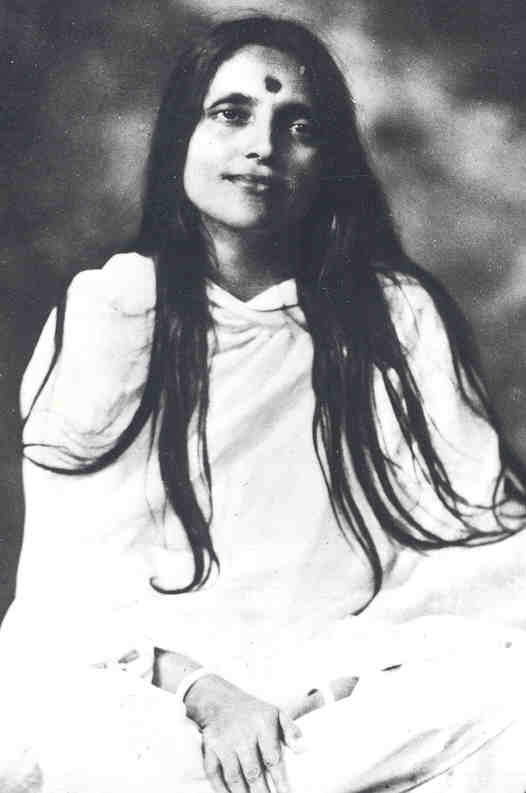
श्री श्री माँ आनन्दमयी (30 April 1896 to 27 August 1982)
Before we look at the horoscopes of women in whom गुरु (Guru/Jupiter) was broken and the apsara archetype walked the earth, we must first establish the opposite pole. We must see what an intact, powerful Jupiter actually produces in the chart and in the life of a woman. Without this baseline, the afflicted charts that follow have no measuring rod.
Anandamayi Ma is that measuring rod.
Who she was
She was born Nirmala Sundari, meaning “Immaculate, Beautiful,” on 30 April 1896 to Bipinbihari Bhattacharya and Mokshada Sundari Devi in the small village of Kheora, Brahmanbaria district, in what is now Bangladesh. Her father was a devout Vaishnava singer who would rise at 3 AM to sing bhajans, and sometimes disappear for days in spiritual wandering. Her mother was a woman of quiet nature and deep inner life. The divine did not arrive in her family as a stranger. It was already present in the atmosphere she was born into.
She was educated for barely 2 years in the village school. By the world’s measure she was nearly illiterate. Although her teachers were pleased with her ability, her family thought she was dullminded because of her constant indifference and happy demeanor. This quality, what the tradition calls the natural ananda of a soul established in the self, was mistaken for stupidity by those around her. People always misread the inner fire of a Type 2 woman because it does not express itself in ways the world recognizes.
The marriage that was not a marriage
At the age of 13, in keeping with the rural custom of the time, she was married to Ramani Mohan Chakrabarti of Vikramapura, whom she would later rename Bholanath.
It was a celibate marriage. Whenever thoughts of sexuality occurred to her husband, Anandamayi’s body would take on the qualities of death and she would grow faint. The universe itself refused to place her in the grihastha register. She had the formal structure of marriage around her, but the svabhava of her soul was so thoroughly beyond the householder mode that even the body would not cooperate with it. Her husband, a grown man, faced with this reality, drew the only intelligent conclusion available to him. He became her disciple instead.
The apsara type woman is formally outside marriage because her Jupiter is broken. Anandamayi Ma was formally inside marriage but spiritually untouchable within it, because her Jupiter was so powerful and so purely oriented toward the divine that the householder mode could not take hold even when the social framework was in place. She is the exact opposite principle, expressed with perfect symmetry.
The spontaneous unfolding
She never sought a guru. She never underwent any formal spiritual training or initiation. At the age of 27, she manifested a profound knowledge of spiritual teachings without any formal training in scriptures, and was able to fluently discuss spiritual matters with learned professors. Scholars who had spent decades studying the texts found themselves sitting at her feet.
Ashrams were established in her name across the subcontinent. Several ashrams, seats of learning, and hospitals were established at Varanasi, Kankhal, Ramna, Kheora, and many other places. There are now around 25 such ashrams bearing her name.
Shri K.N. Rao identify her as an अंशावतार (amsha-avatar) in the truest sense of the term. The specific parameters that create this classification are visible in the natal chart, and this is where we now turn.
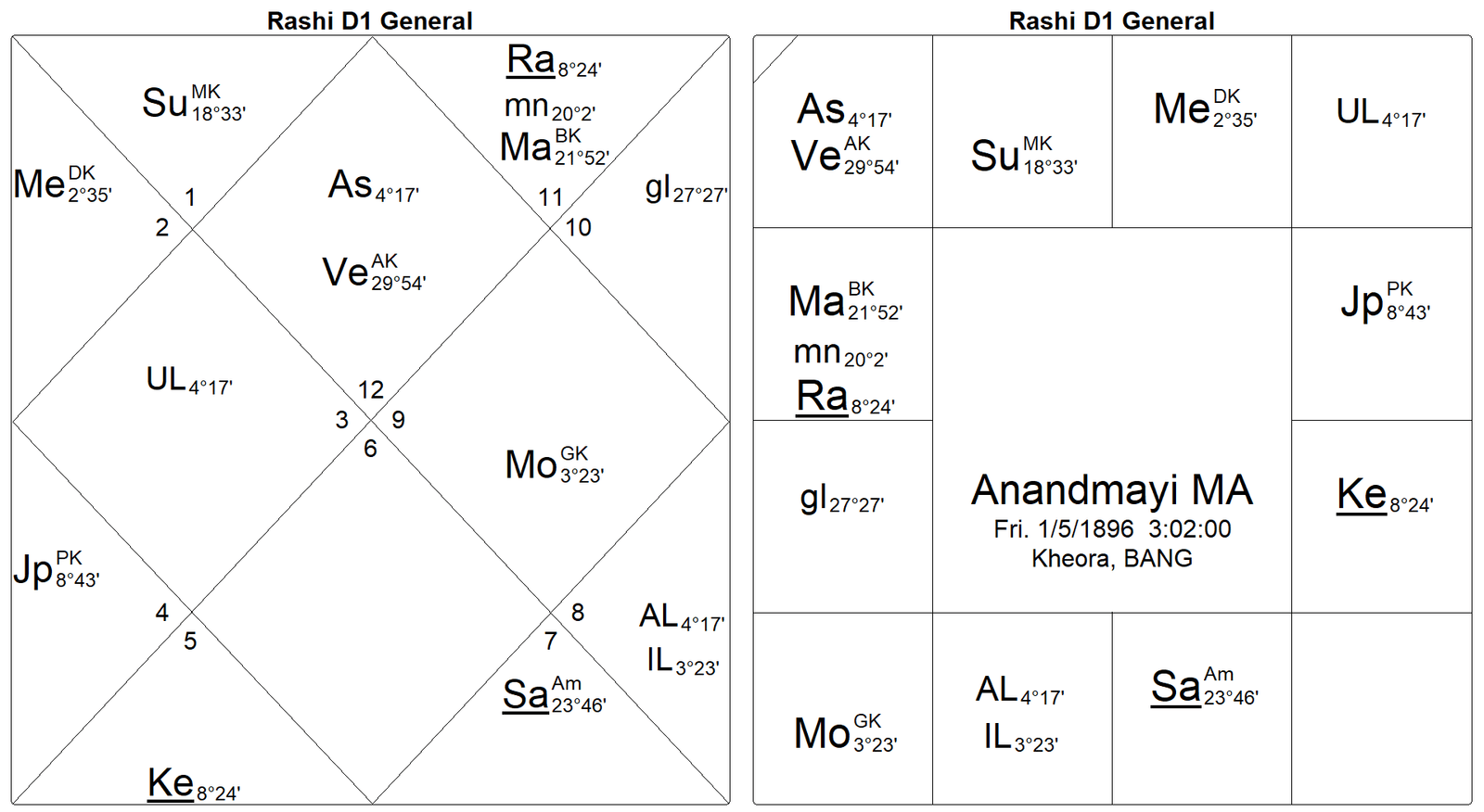
Astrological Analysis
लग्न और लग्नेश (Lagna and Lagna Lord)
- लग्न: मीन (Meena / Pisces). Jupiter is the lagna lord. The very first house of the chart establishes the soul’s orientation entirely within Jupiter’s domain, the domain of dharma, wisdom, expansion, and the divine.
- लग्नेश गुरु (Jupiter) is exalted in the 5th house, in the Pushya nakshatra (पुष्य नक्षत्र). This is one of the most auspicious possible placements for a lagna lord. Pushya is considered the most nourishing of all 27 nakshatras, sacred to Brihaspati himself, the devaguru. Jupiter, the lagna lord, sitting exalted in his own nakshatra in the 5th house of disciples, wisdom, and divine blessings, is not just a strong Jupiter. It is Jupiter at his most complete and undistracted expression.
The Great Exchange: 5th and 10th Lords
- चन्द्र (Moon) is the 5th lord for Meena lagna (5th house = Karka / Cancer, ruled by Moon). Moon is placed in the 10th house. Jupiter is placed in the 5th house. This creates a continuous, evergreen parivartana yoga (exchange) between the 5th lord and the 10th lord, between the house of disciples and the house of karma and public life. The 2 most powerful trikona-kendra combination possible in the chart are in a constant mutual exchange. This is why her entire public karma (10th house) was inseparable from her role as a guru to thousands (5th house), and why her disciples came from the highest levels of public life.
- चन्द्र is in Moola nakshatra (मूल नक्षत्र), the nakshatra of Ketu. The lord of the nakshatra in which the Moon sits shapes the deepest emotional and life purpose of the person. Ketu is the planet of the monk, the renunciant, the one who has already transcended worldly attachment. The Moon, which represents the mind, emotions, and the woman herself in Stree Jataka, has its life purpose anchored entirely in Ketu’s territory. Detachment, liberation, and the transcendence of the mundane world were not chosen paths for her. They were the deepest emotional instinct of her nature.
शुक्र (Venus): The Atmakaraka Goddess
- शुक्र (Venus) is exalted in the लग्न (1st house). For Meena lagna, Venus in Meena is in its exaltation sign. The planet that represents the woman herself, her inner quality and outer grace, is in the lagna at maximum strength. She is, in the most literal astrological sense, the goddess standing in full power at the threshold of the chart.
- Venus is aspected by गुरु (Jupiter) from the 5th house. Exalted Jupiter aspects exalted Venus. The 2 greatest benefics in the chart are both exalted and in mutual aspect. The grace flowing between them is unobstructed and complete.
- Venus is the 8th lord for Meena lagna (8th house = Tula / Libra, ruled by Venus). The 8th house governs occult knowledge, deep sadhana, hidden mysteries, and transformation. Venus as 8th lord placed in the lagna, exalted and aspected by Jupiter, means the entire force of the occult and the depths of sadhana are channeled directly into her being, into her very personality and presence. This is why she entered spontaneous yogic states without any formal training. The 8th house knowledge was not studied. It lived in her body.
- Venus is वर्गोत्तम (vargottama), meaning it occupies the same sign (Meena) in both the birth chart and the navamsha. Vargottama planets carry double strength and operate with extraordinary purity and consistency across both outer life and inner soul. She did not become spiritual in later life. She was born this way and remained this way without deviation across 86 years.
- Venus is the आत्मकारक (Atmakaraka), the planet with the highest longitude in the chart. In Jaimini astrology, the Atmakaraka is the planet that represents the soul’s deepest purpose and its journey through this birth. Her Atmakaraka is Venus, exalted, vargottama, in the lagna. The soul’s purpose in this birth is the goddess principle itself, beauty in its highest form, grace in its most complete expression, divinity made visible.
करकांश लग्न (Karakamsha Lagna)
- The Karakamsha, which is the navamsha sign of the Atmakaraka (Venus), falls in मीन (Meena / Pisces). This is the same as her birth lagna. Jaimini Maharishi states in the Jaimini Sutras: If the Karakamsha falls in Meena, the native is a liberated soul who attains moksha in this very birth or immediately after it. This principle applies with complete precision to Anandamayi Ma. She did not merely live a spiritual life. She demonstrated, in 86 years of unbroken divine consciousness, the state of liberation walking the earth in human form.
विवाह और द्वितीय भाव (Marriage and the 2nd House)
- The 7th house (house of marriage) is in पाप कर्तरी योग (Paap Kartari Yoga), trapped between 2 malefic planets. Ketu occupies the 6th house on 1 side and Shani (Saturn) occupies the 8th house on the other. The 7th house is thus sandwiched between these 2 separating, renouncing forces. The chart itself was built with a wall around conventional marriage. The union could be formal but never real. The Paap Kartari on the 7th house is the precise astrological explanation for why her husband could not approach her as a wife.
- The 2nd house governs family creation, the establishing of a household lineage, and what the tradition calls the गृहस्थ धर्म of a woman. The 2nd house in this chart has significant afflictions:
- The 2nd lord (Mars, ruling Mesha / Aries = 2nd house from Meena) is placed in the 12th house. The lord of the house of family is in the house of dissolution, renunciation, and the beyond.
- The 2nd house is aspected by Shani (Saturn).
- Saturn in the 8th house and Sun in the 2nd house create a direct opposition on the 2nd-8th axis. This Saturn-Sun opposition strikes the mangalya axis directly. The tradition understands mangalya as the auspiciousness and continuity of the married state for a woman. Here that axis is under the pressure of the harshest possible opposition.
- These 2nd house afflictions, read together with the 7th house Paap Kartari, confirm at the level of pure mathematical Jyotish what the biography confirms in lived fact. No conventional family was possible. No conventional marriage was possible. The chart did not allow it, not because of a defect, but because this soul was built for something entirely beyond the domestic register.
The Spiritually Elevated Woman: Horoscope 2

श्री माता अमृतानन्दमयी देवी (born 27 September 1953)
Some souls cannot truly be described in words. They can only be pointed at. Mata Amritanandamayi is one such soul. She is a गुणातीत (gunateeta) personality, one who has moved entirely beyond the play of the 3 gunas, and the inner experiences of a being like this are not something an ordinary mortal pen can capture. So what follows is offered as a humble attempt, knowing fully that the reality is far beyond the chart and far beyond these pages.
She was born on 27 September 1953, the 4th child of Sugunandan and Damayanti, a pious but very poor fisherman family on the coast of Kerala. They named her Sudhamani, which means “pure jewel.” There is a striking detail about her birth. The colour of the baby was dark blue at first, and later it turned black, as though the very hue of Krishna and Kali had passed through this little body. Her father was a devout Krishna bhakta and her mother a Devi upasika, and through the entire period of her conception, both of them are said to have had repeated visions of Krishna and Devi. The 2 deities she would one day fully embody had already begun visiting that humble home before she even arrived in it.
She started school at the age of 5 and had a remarkably sharp memory. But her mother fell into chronic illness, and the entire burden of the household fell on her small shoulders. She had to leave her studies after the 4th grade. Krishna was her first beloved deity, and from her earliest years she lived in a state of God-intoxication that her own family simply could not understand. They thought she was mentally unwell. She was treated like a servant in her own home, locked out of the house, and at times denied even food.
At the end of 1975, she attained her great mystic union, and the Krishna bhava began to manifest through her. Before long, the Devi bhava arose in her as well. A committee of wealthy local landlords, calling itself a movement of rationalists, set out to destroy her. They filed complaints with the police, gave her milk laced with poison, and even hired a black magician to finish her. Every single attempt failed and faded into nothing. On 6 May 1981, the Mata Amritanandamayi Math was founded, and the world slowly came to know her by the only name that ever truly fit her. Amma. The Mother.
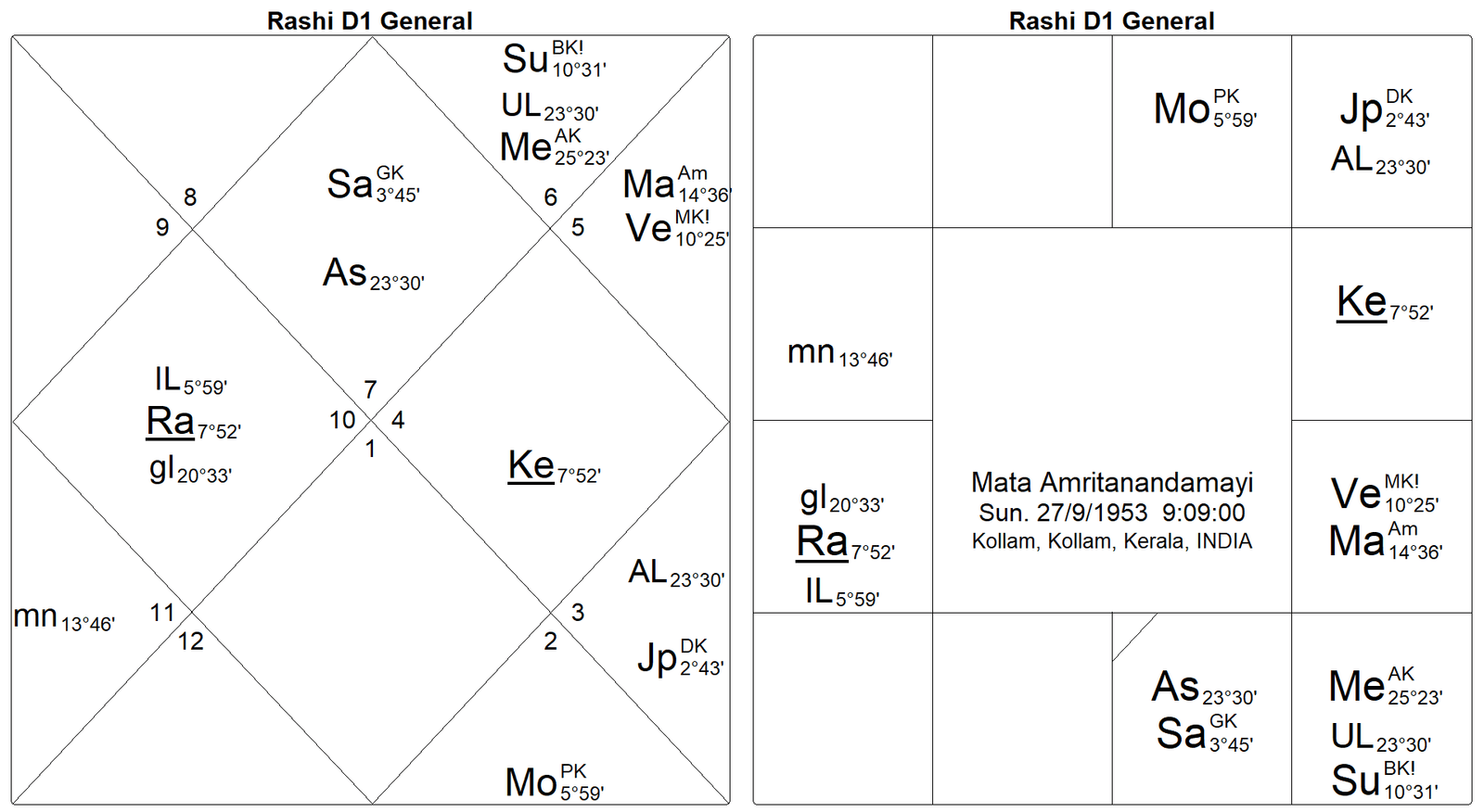
Astrological Analysis
Let us read this horoscope carefully, placement by placement, and see what kind of soul the chart describes.
The lagna and the exalted 5th lord of Purva Punya
- The लग्न is तुला (Libra). The lagna lord शुक्र (Venus) is placed in the 11th house.
- शनि (Saturn) is exalted in the लग्न itself, in Libra. For Tula lagna, Saturn is the 5th lord, the lord of Purva Punya, the spiritual merit carried forward from past lives. To have this 5th lord of past-life merit sitting exalted in the very 1st house is one of the most powerful spiritual indications a chart can hold. It says the soul did not arrive in this birth empty-handed. It came already rich, carrying the accumulated tapasya of many lifetimes into the present one.
- And the lagna lord Venus, sitting in the 11th house, casts its aspect directly onto the 5th house. So the 5th house, the seat of past-life merit and upasana, is strengthened twice over, once by its own lord exalted, and again by the aspect of the lagna lord.
The exalted 10th lord of karma
- The 10th lord चन्द्र (Moon) is exalted, placed in the 8th house of secret sadhana. The mind and the karma are both in an exalted state.
- Read this together with the previous point and a beautiful picture emerges. The 5th lord exalted says her past-life merit was immense. The 10th lord exalted says the work she is given to do in this life is equally elevated. The soul arrives rich, and is then handed divine work to perform. Not ordinary karma. Exalted karma. And the Moon performing this karma from the 8th house tells you the work is done through deep, hidden sadhana, not through outward show.
The exalted 9th lord of dharma and the ashram link
- The 9th lord बुध (Mercury) is exalted, placed in the 12th house, conjunct the Sun.
- The 9th house is dharma. The 12th house is the ashram, the foreign land, moksha, the dissolution of the worldly self. When the lord of dharma sits exalted in the house of withdrawal and the beyond, it writes a clear instruction into the chart. This is a soul whose dharma is to build ashrams, to cross oceans, and to lead others toward liberation. Her life became exactly this.
Jupiter, the karaka of dharma, sitting in the house of dharma
- Now here is a point of the greatest importance for understanding this woman. गुरु (Jupiter) is the natural karaka, the significator, of the 9th house, of dharma, of the guru-principle itself, of higher wisdom and spiritual knowledge. And in this chart, Jupiter is placed in the 9th house itself.
- This is the karaka sitting in its own bhava, the significator of dharma resting in the very house of dharma. And this Jupiter is in no way afflicted. It is beautifully, cleanly posited in the 9th. From there it throws its benefic aspect onto the lagna and onto the 5th house, blessing both the self and the seat of upasana with its grace.
- This single placement deserves to be paused upon, because it is the heart of the matter. In the women we will study later in this article, Jupiter is broken, fallen, or trapped in a dusthana, and the result is the earthbound apsara. Here Jupiter is whole, dignified, and seated in its own house of dharma. The same planet, treated kindly by the chart, produces not a sex symbol but a Guruma worshipped by millions. Jupiter as the significator of spiritual knowledge here signifies her complete establishment in peace.
Ketu, the planet of moksha, commanding the 10th house
- केतु, the karaka of moksha and the planet of the renunciate, sits in the 10th house in Cancer. The 10th house is the house of public action, of the work shown to the world. With Ketu commanding it, her entire public life is soaked in the energy of renunciation. Whatever she does in the eyes of the world is pointed, at its root, toward liberation rather than worldly gain.
- See now how the chart stacks its evidence. The 5th lord of past merit, exalted. The 10th lord of karma, exalted. The 9th lord of dharma, exalted. The karaka of dharma, Jupiter, seated in the 9th house itself and unafflicted. And Ketu, the great renouncer, ruling the house of public life. Every pillar of dharma and moksha in the chart is glorified at once. This is not the horoscope of an ordinary devotee. It is the horoscope of a being sent to do the work of the divine in the open world.
The Rhyme with Anandamayi Ma
Now place this chart beside the horoscope of Anandamayi Ma, and something quietly astonishing appears. 2 different women, 2 different eras, 2 different corners of India, and yet the same spiritual signature is written into both charts, almost line for line.
- In Anandamayi Ma’s chart, exalted गुरु, the lagna lord, sat in the 5th house in Pushya nakshatra, with a full exchange between the 5th and 10th lords. Here, the 5th lord Saturn is himself exalted, and the lagna lord aspects the 5th. The 5th house, the seat of past-life merit, is glorified in both.
- Anandamayi Ma had her 10th lord exalted. Mata Amritanandamayi has her 10th lord exalted. The karma of both was lifted to its highest possible expression.
- Anandamayi Ma carried the ashram link of the 9th lord connected to the 12th house. Mata Amritanandamayi has the 9th lord exalted in the 12th house. The same dharmic mission of building ashrams and crossing oceans is written into both.
- And the most beautiful rhyme of all sits in the 10th house. In Anandamayi Ma’s chart, the Moon sat in the 10th house in the Moola nakshatra of Ketu, so her public life was soaked in Ketu’s renunciate energy. In Mata Amritanandamayi’s chart, Ketu itself sits in the 10th house, and the Moon that carries that Ketu connection is itself the 10th lord. The same truth, told 2 different ways.
When you lay these 2 horoscopes side by side, the conclusion is impossible to avoid. The 5th lord of past merit, the 9th lord of dharma, the 10th lord of karma, all exalted. Jupiter dignified and pointed at dharma. Ketu commanding the house of public action. 2 charts, 2 women, separated by half a century, carrying 1 unmistakable spiritual signature.
The अप्सरा in the Horoscope
We have seen the heights. An unafflicted गुरु seated in its own house of dharma. The 5th lord of past merit, the 9th lord of dharma, the 10th lord of karma, all lifted into exaltation. केतु commanding the house of public life and turning the whole existence toward moksha. That was the chart of the साध्वी-विरक्ता, the woman in whom the divine feminine rises clean and unobstructed.
Now we turn the chart over and look at the other face.
What happens when that same गुरु, the patikaraka, the lord of a woman’s dharma and the anchor of her marital and spiritual life, is broken? Not missing, because Jupiter is never missing from a chart. But broken. Fallen into debilitation, burnt close to the Sun, dropped into a dusthana, or fenced in on both sides by cruel planets. What kind of life does the chart then write?
She becomes the अप्सरा. The celestial nymph who rose from the churning of the ocean, dazzling beyond measure, desired by the whole world, and yet unable to set down roots in the quiet soil of a single dharmic home. The very beauty that in a balanced chart would have lit up one household now spills outward and belongs to everyone and therefore to no one. She is worshipped by millions and possessed by none. This is not a lesser soul. As we have already seen, the tradition never calls her fallen. It is simply a different dharmic station, written by a broken गुरु into the chart of an extraordinary woman.
We now turn to the real horoscopes that carry this signature. And we must begin where the modern story of the अप्सरा truly begins, with the woman whose very name became another word for the goddess of the screen.
The अप्सरा in the Horoscope: Chart 1

Marilyn Monroe (1 June 1926 to 5 August 1962)
She was not born Marilyn Monroe. She was born Norma Jeane Mortenson on 1 June 1926 in Los Angeles, the daughter of Gladys Pearl Mortensen, a film-cutter whose own mind would soon give way. The father’s name was never even recorded in the birth data. From the very first breath, the karaka of the father and the anchor of the home were missing from her life, just as they would prove missing in her chart.
Her mother’s sanity collapsed, and the little girl was handed into foster homes for the first 7 years of her life. The only warmth she knew came from her mother’s friend, Grace McKee, who would tell her, “Don’t worry, Norma Jeane. You’re going to be a beautiful girl when you get big, an important woman, a movie star.” It was a prophecy and a curse in the same breath. She suffered sexual abuse at the age of 8. She began working in a factory at 16. From there a photographer found her, modelling led to films, and films led to a fame so enormous that the world forgot Norma Jeane entirely and remembered only the dazzling creation called Marilyn Monroe.
She made 30 films and left 1 unfinished. In a life lasting a mere 36 years she became, and remains to this day, the single most recognised sex symbol the modern world has ever produced. She was the अप्सरा made flesh in the age of the camera.
And she understood, with a painful clarity, exactly what she had become. In her own words: “I knew I belonged to the public and to the world, not because I was talented or even beautiful, but because I had never belonged to anything or anyone else.” And again, even more sharply: “A sex symbol becomes a thing.”
There it is, in her own voice. Desired by all, belonging to none. Married 3 times and rooted nowhere. She was laid to rest at the age of 36 in Westwood Memorial Park, Los Angeles. The chart that produced this life is the subject we turn to now, and at its very centre, exactly where the साध्वी carried an exalted Jupiter, Marilyn Monroe carried a broken one.
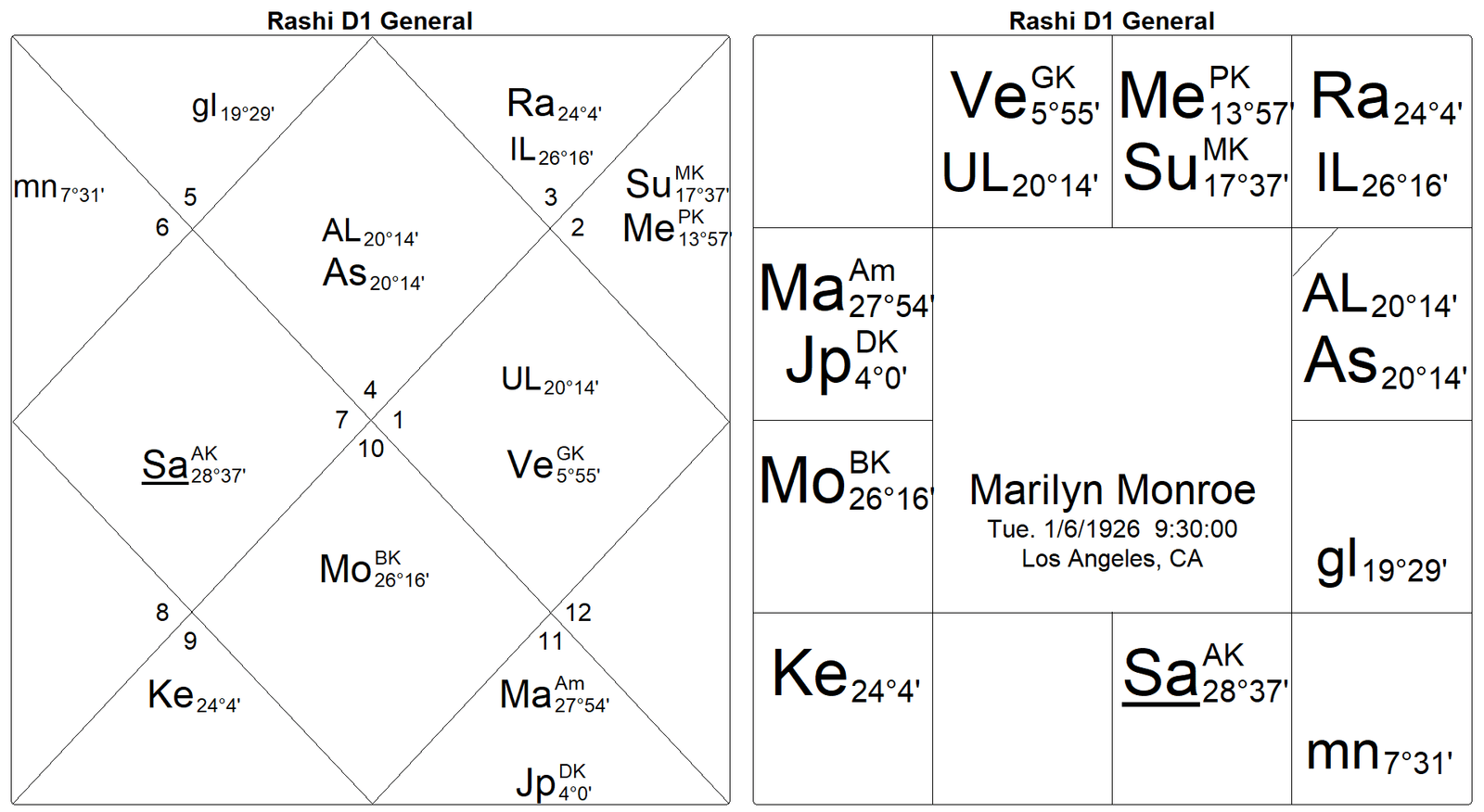
Marilyn Monroe: The Structure of the Chart and the Matter of Relationships
The Basic Structure of the Horoscope
- The लग्न is कर्क (Karka / Cancer), and the lagna lord is चन्द्र (Moon). This Moon carries a double weight in the chart. It is the lagna lord, representing her body and self, and it is also the natural karaka of the woman herself in Stree Jataka, her mind and emotional core. So wherever the Moon sits, she sits.
- This Moon is placed in the 7th house, in मकर (Capricorn), the cold sign of शनि (Saturn). The woman herself is placed not in her own 1st house but in the 7th, the house of the other, of partnership, of the public and the marketplace. She does not belong to herself. She belongs to the one across from her, and to the world. Sitting in Saturn’s sign, she was drawn repeatedly to men much older than herself.
- The single most defining placement of the chart: गुरु (Jupiter), the 9th lord of dharma and fortune and the patikaraka or husband-significator, is placed in the 8th house in कुम्भ (Aquarius), conjunct मंगल (Mars). The 8th is the house of sudden falls, hidden things, scandal, and raw sexual energy without sanctity. The very planet that should have anchored her in a stable, dharmic marriage is dropped into the deepest pit of the chart and joined to Mars, the planet of raw passion.
- This is the exact inversion of the elevated charts. Anandamayi Ma had गुरु exalted in the 5th house in Pushya nakshatra. Mata Amritanandamayi had गुरु clean and dignified in its own 9th house. Marilyn Monroe has the same patikaraka fallen from the temple into the 8th. From this single fall, the entire apsara life unfolds.
- शनि (Saturn), the 7th lord of marriage, is exalted but retrograde, placed in the 4th house. It is strong enough to give fame through Shasha yoga, but it is retrograde, turned backward and withdrawn, and the classics note this exaltation comes with bad conduct. The marriage lord is powerful but pointed the wrong way.
- शुक्र (Venus), the planet of beauty and physical desire, sits in मेष (Aries), a hot Mars-ruled sign, in the 10th house of public life. Her sexuality was not private. It was placed in the most public house of the chart for the whole world to consume. Venus in Aries, as the classics state plainly, makes a woman sexually oriented and forward.
- राहु (Rahu), the great amplifier and planet of insatiable craving, sits in the 12th house of the bed and bodily pleasures, and is aspected by the same broken गुरु from the 8th. The fallen husband-significator casts its gaze directly upon the house of the bed.
- The structure is therefore complete. The woman herself placed in the house of others. The husband-giver broken in the 8th. The marriage lord retrograde and turned away. Venus and her sexuality hoisted into the public 10th. Rahu inflaming the house of the bed. This is not the chart of a wife. It is the chart of the earthbound nymph.
The Matter of Relationships and Marriage
- She married 3 times. James Dougherty in 1942, the baseball legend Joe DiMaggio in 1954, and the playwright Arthur Miller in 1956. Beyond the marriages came the affairs, most famously the rumoured relationships with President John F. Kennedy and his brother Robert Kennedy. 3 husbands, none of whom could hold her, and a string of powerful men, none of whom she could belong to.
- The चन्द्र (Moon), as lagna lord and as the woman herself, sits in the 7th house. The ancient rule is clear: the Moon in the 7th house gives multiple marriages. The very placement that put her self in the house of partnership also guaranteed the partnerships would be many and none would be final.
- The patikaraka गुरु is broken in the 8th house. The husband principle in her chart had no firm ground. A woman with a dignified Jupiter draws 1 worthy husband and roots beside him. A woman whose Jupiter has fallen into the 8th draws husbands the way the 8th house draws everything, suddenly and intensely, then loses them just as suddenly. Marriage after marriage formed and collapsed into that pit.
- The timing seals it. Every one of her marriages and famous affairs unfolded during the Mahadasha of गुरु. The broken patikaraka sitting in the 8th was the very planet ruling the longest and most defining period of her adult life. The same Jupiter that should have protected her became the engine of her chaos. The glory and the disaster of her life were both the mahadasha of Jupiter, the 6th and 9th lord, in raj yoga but placed in the 8th house.
- This is the apsara condition expressed in 1 human life. She was desired by the most powerful men in the world, married 3 times over, and belonged in the end to no 1 person and no 1 home. The beauty was real. The fame was beyond measure. But the dharmic anchor that गुरु gives a woman when it sits unbroken was the 1 thing she was never given in this birth. She was, in the truest shastric sense, the celestial nymph who dazzled the whole world and never once found a home to call her own.
The अप्सरा in the Horoscope: Chart 2

Madonna (born 16 August 1958)
If Marilyn Monroe was the अप्सरा of the silver screen, Madonna is the अप्सरा of the modern age of sound, image, and spectacle. Where Marilyn’s allure was soft, wounded, and almost childlike, Madonna’s was the very opposite. Hard, deliberate, defiant, and armoured. She did not drift into fame the way Marilyn did. She seized it, shaped it, and weaponised it. And in doing so she became, for an entire generation, the most provocative female figure on the planet.
She was born Madonna Louise Ciccone on 16 August 1958 in Bay City, Michigan, into a devout Italian-American Roman Catholic family. The very name her parents gave her, Madonna, means the Holy Mother herself, the Virgin Mary. There is a strange and telling irony in that, because the woman who carried this most sacred of names would spend her career turning the symbols of that same faith on their head, mixing the imagery of crucifixes and saints with open sexuality until the Church that raised her publicly condemned her.
Her mother died when Madonna was only 5 years old. That early wound, the loss of the mother, sits at the root of her story, and the chart will show us exactly where it is written. She was a bright and disciplined child, always first in her class, and she carried within her from a young age a ferocious refusal to ever be defeated. When she lost, she did not collapse. She trained herself harder. That iron will would later become the engine of her entire career.
She arrived in New York City in 1978 with 35 dollars in her pocket, worn-out shoes, and an almost unreasonable confidence in her own destiny. From a struggling dancer she rose, through sheer force of ambition, into the single most successful female recording artist the world had yet seen. She reinvented herself again and again, decade after decade, always staying ahead of the culture, always provoking, always refusing to settle into any fixed role, any fixed image, or any fixed relationship.
And that final point is the key to reading her as the अप्सरा. Like every woman of this archetype, she belonged to the world’s gaze and never to a single stable home. Marriages came and went. Reinventions came and went. The whole planet watched her, desired her, argued about her, and yet no single dharmic anchor ever held her in place. The same broken गुरु that defined Marilyn Monroe is at work here too, but in Madonna it produces something even sharper. Not the tragic, fragile nymph, but the defiant, unbreakable one who turned her own rootlessness into a global throne.
At the centre of her chart sits a yoga that explains all of this at once, the गुरु-चाण्डाल योग (Guru-Chandal Yoga), the meeting of गुरु and राहु, the planet of dharma joined to the planet of boundary-breaking craving. It is the perfect signature for a woman who took the most sacred name in her religion and became the most famous rebel against it.
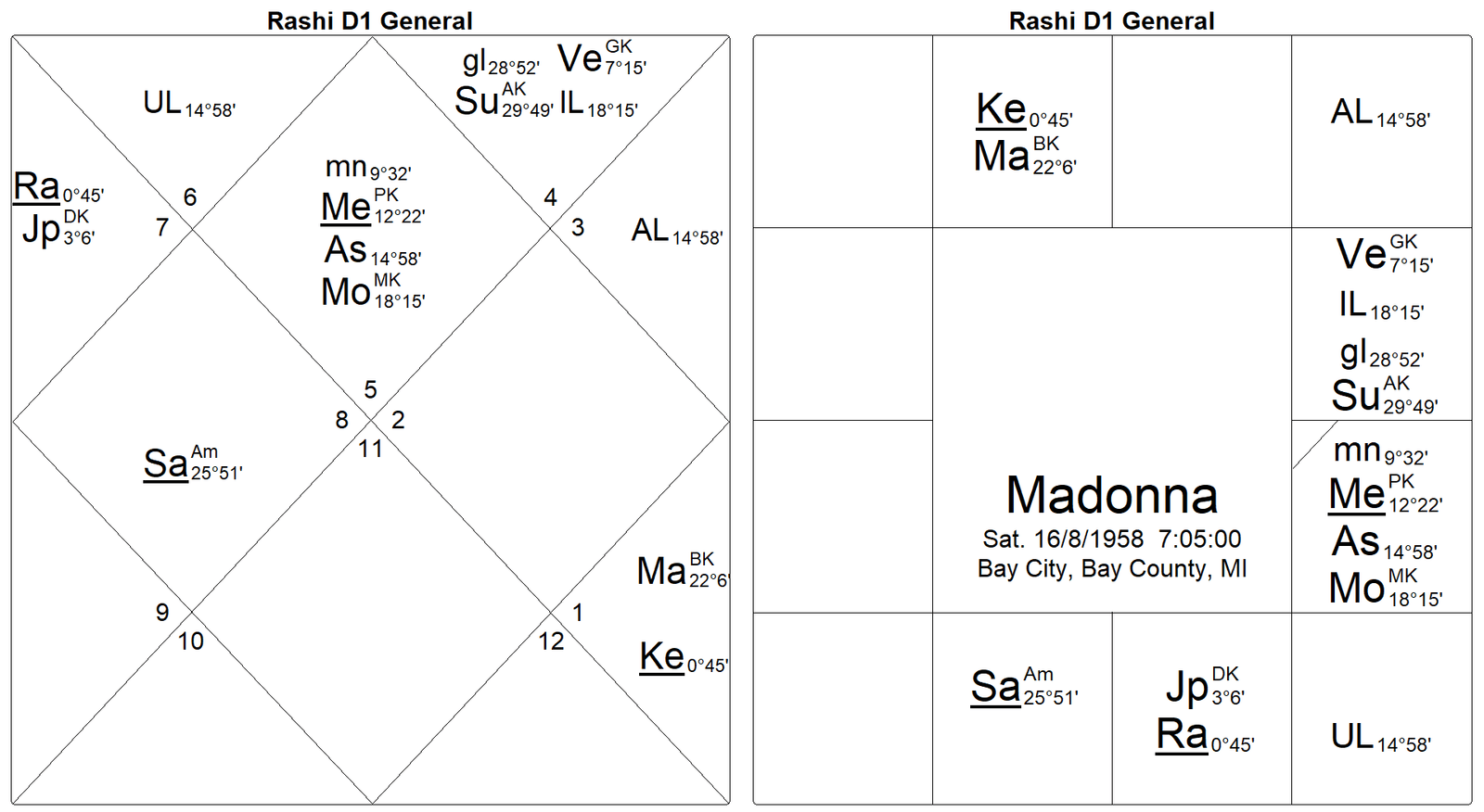
Horoscope Analysis
- The लग्न is सिंह (Simha / Leo). The lion’s sign by its very nature gives a powerful sense of individuality, visibility, dominance, and a deep urge to express oneself forcefully before the world. This is already the chart of someone who is built to be seen.
- In the lagna itself sit चन्द्र (Moon) and बुध (Mercury) together. Both are worldly, mundane planets in this context. Mercury naturally keeps the mind locked into interaction, communication, intellect, and the machinery of everyday worldly functioning. The Moon joining Mercury deepens that involvement further, pulling her into public image, emotional expression, and constant mental activity.
- Because this combination sits in the ascendant itself, any complete withdrawal from worldly life becomes almost impossible for her. The personality stays permanently wired into society, expression, attention, and the hunger for external experience. This is not a chart that can sit quietly in a cave. It is a chart that must perform.
- The lagna lord सूर्य (Sun) is placed in the 12th house, joined with शुक्र (Venus). This is a very telling combination. Venus naturally amplifies the pull toward pleasure, relationships, beauty, luxury, and sensual experience, while the Sun sitting there hands a strong personal identity to those very desires. Her sense of self becomes fused with pleasure and attraction.
- This Sun-Venus conjunction is further aspected by मंगल (Mars). Mars injects passion, intensity, impulsiveness, and raw force. As a result, the significations of the 12th house, especially on the material and sensual plane, become far stronger and far more charged.
- So observe the structure. The Leo ascendant already craves recognition and self-expression. When its lord travels to the 12th house, joins Venus, and receives the aspect of Mars, the chart develops a powerful inclination toward passionate worldly involvement and intense material experience. The self is pointed outward, into pleasure and display, not inward toward renunciation.
- The next defining combination is गुरु (Jupiter) conjoined राहु (Rahu). Jupiter is the karaka of dharma, wisdom, ethics, higher guidance, and purity of direction. But when Rahu joins Jupiter, the गुरु-चाण्डाल योग (Guru-Chandal Yoga) is formed, and the clean voice of dharma becomes clouded and distorted by Rahu’s boundary-breaking craving.
- This conjunction occurs in a sign of Venus. Once again the chart turns toward worldly enjoyment, attraction, relationships, glamour, and the breaking of conventional moral boundaries. The dharma-karaka itself is sitting in the territory of desire.
- Jupiter further receives the aspect of मंगल (Mars). This is significant, because the Mars-Jupiter connection often produces a tendency to challenge and confront established social norms, and that tendency becomes far sharper when Rahu is also influencing the combination. The result is not quiet dharma but rebellious dharma, dharma turned on its head.
- A similar pattern was visible in the horoscope of Marilyn Monroe. In her chart too, Jupiter carried a strong Rahu influence, placed as it was in Aquarius, a sign connected to Rahu in many traditional interpretations. There too the chart showed a clear tendency to move outside conventional societal structures. The 2 great अप्सरा charts of the modern age rhyme with each other at exactly this point: the breaking of गुरु.
- In Madonna’s chart the influence runs even deeper, because Jupiter, Rahu, and Mars are connected not only in the Rashi chart but also in the Navamsha.
- Jupiter, Rahu, and Mars all fall in the same Navamsha. This shows that the affliction to Jupiter does not soften at the deeper karmic level. It continues. Normally the Navamsha can sometimes give relief or a spiritual correction to a troubled planet, but here that relief simply is not present. The wound to dharma is carried all the way down into the soul-chart.
- As a result, the dharma-karaka Jupiter remains heavily pressed by Rahu and Mars even in the deeper divisional structure of the chart. This produces a personality that, consciously or unconsciously, challenges traditional morality, defies social expectation, and pushes against accepted norms of conduct at every turn.
- So while the chart unquestionably carries charisma, visibility, magnetism, and tremendous worldly power, the condition of Jupiter tells the deeper story. The guidance of dharma in her life is constantly under pressure from desire, passion, rebellion, and unconventional impulse. The compass that should point toward higher law keeps getting pulled toward the world.
- She is born in the पूर्व फाल्गुनी (Purva Phalguni) nakshatra, the nakshatra ruled by शुक्र (Venus). So at the deepest level, her entire life revolves around Venus, around pleasure, beauty, attraction, performance, and sensual expression. The very star she was born under set the theme of her existence, and the broken गुरु ensured there was no dharmic anchor to balance it.
The अप्सरा in the Horoscope: Chart 3

Brigitte Bardot (28 September 1934 to 28 December 2025)
If Marilyn Monroe was the अप्सरा of Hollywood and Madonna the अप्सरा of the modern age of spectacle, then Brigitte Bardot was the अप्सरा of European cinema, the woman who more than any other came to embody the very idea of French beauty and sensual freedom in the eyes of the entire world.
She was born Brigitte Anne-Marie Bardot on 28 September 1934 in Paris, into a wealthy bourgeois Roman Catholic family. Her father Louis Bardot was a prosperous industrialist who was also a poet and amateur filmmaker, and her mother Anne-Marie was a society woman devoted to fashion and ballet. There is a charming detail in her very name. Her initials, BB, sound like bébé, the French word for baby, and that nickname would one day define her across the world. Her parents raised her and her younger sister strictly, with close attention to manners and education.
Her mother enrolled her in dance from a young age, and her natural talent was clear. She was accepted into the Conservatoire de Paris in 1947 and trained in ballet for 3 years. That dancer’s grace would later give her screen presence its hypnotic quality. At the age of 15, she appeared on the cover of Elle, France’s leading women’s magazine, on 8 May 1950. The young aspiring director Roger Vadim saw that cover and would go on to shape both her public image and her career.
She made her film debut in 1952 in Crazy for Love, and in the same year, at just 18, she married Vadim. But it was their 1956 film, And God Created Woman, that transformed her into an international sensation. Playing a sexually liberated orphan in Saint-Tropez whose beauty captivates every man around her, she became, almost overnight, a global symbol of the sexual revolution. The philosopher Simone de Beauvoir devoted a 1959 essay to her, The Lolita Syndrome, calling her “a locomotive of women’s history” and the most liberated woman of France. She is widely credited with popularising the bikini.
And yet, behind the dazzling surface, the familiar pattern of the archetype repeats with painful exactness. She married 4 times, to Roger Vadim, Jacques Charrier, the German millionaire Gunter Sachs, and finally Bernard d’Ormale. She had 1 son, Nicolas, whom she did not raise herself. At the very height of her fame, while filming La Vérité, she attempted suicide on her 26th birthday. Adored by millions, desired across continents, she could never seem to find the still, rooted centre that the world assumed such a goddess must surely possess.
In 1973, just before turning 40, she walked away from cinema entirely, saying she had tired of being looked at, and devoted the rest of her long life to the cause of animals. She died on 28 December 2025 in Saint-Tropez, at the age of 91. The years of her stardom drew the archetype perfectly. Extraordinary beauty, worldwide desire, 4 marriages, and no lasting anchor. The same signature traced through Marilyn and Madonna repeats once more, in a different language and a different country, but with the same underlying truth.
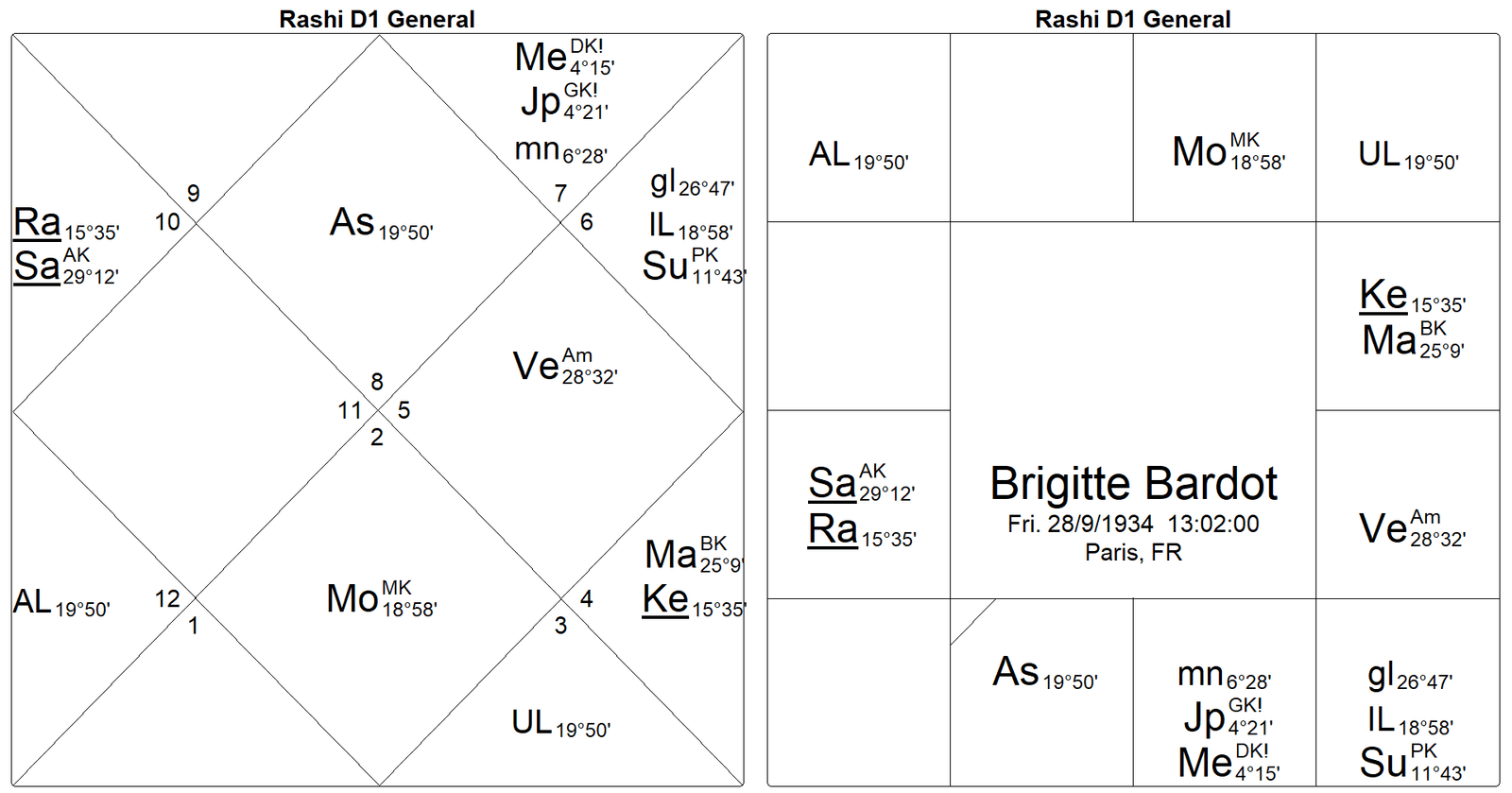
Horoscope Analysis
- The first and most important thing to look at in this chart is the nakshatra in which she is born. She is born in रोहिणी (Rohini), the most sensual and beauty-laden nakshatra of all 27. Rohini is the favourite nakshatra of चन्द्र (Moon) himself, the star of attraction, fertility, charm, and magnetic physical beauty. To be born in Rohini is to carry the very signature of sensual allure in the deepest layer of the chart.
- Rohini is lorded by the चन्द्र (Moon), and in her chart this Moon is exalted. An exalted Moon, the natural karaka of the woman herself, and it is aspecting her लग्न directly. So 1 of the 2 feminine planets that define a woman in Stree Jataka is placed in real strength and is throwing its gaze upon her ascendant, pouring beauty and emotional magnetism straight into her personality.
- The other feminine planet, शुक्र (Venus), is placed in the 10th house. This is strikingly similar to what we saw in the horoscope of Marilyn Monroe, whose Venus also sat in the 10th house. In both women the planet of beauty and desire is hoisted into the most public house of the chart, placed on display for the entire world to gaze upon. The sensuality is not private. It is the very thing the public consumes.
- So already we see the same foundational structure as the earlier अप्सरा charts. The 2 feminine planets, Moon and Venus, are strong and prominent and outward-facing. The woman herself is built for beauty, attraction, and public desire. Now we turn to the condition of गुरु, and there the pattern completes itself.
- गुरु (Jupiter) is placed in the 12th house, and it is being aspected by both शनि (Saturn) and मंगल (Mars). The patikaraka and the lord of dharma is hemmed in and pressed by the 2 great malefics at once. The husband-significator and dharmic anchor of the chart is afflicted, exactly as it was in Marilyn and in Madonna.
- This Jupiter is also very closely tied to बुध (Mercury), the 8th lord, in the sign of तुला (Libra). This is almost a direct echo of Madonna’s chart, where the broken Jupiter was bound up with the worldly, mundane planets. Here too, the dharma-karaka is fused with the lord of the 8th, the house of hidden things, scandal, and sudden upheaval. Dharma gets tangled with the very energies that pull a life off its dharmic course.
- Now look at the 9th house, the house of dharma itself, which in her chart is कर्क (Cancer), the exaltation sign of Jupiter. One would expect this to be a saving grace. But this 9th house is heavily afflicted. It holds both मंगल (Mars) and केतु (Ketu), and it receives the aspect of शनि (Saturn) as well. So the 1 place in the chart where Jupiter could have found his strength, his own exaltation sign in the house of dharma, is itself crowded with malefics and broken open. There is no refuge for dharma anywhere in the chart.
- The conclusion writes itself. With dharma afflicted from every direction, the broken Jupiter pressed by Saturn and Mars, and the 9th house torn apart, it is शुक्र (Venus) and चन्द्र (Moon), beauty and desire, that step forward and take the main stand in this life. The feminine, sensual planets command the chart, and the dharmic, anchoring planet is left wounded and unable to hold the centre. This is the precise mathematical condition of the अप्सरा.
The अप्सरा in the Horoscope: Chart 4
Zeenat Aman (born 19 November 1951)
With Zeenat Aman the अप्सरा archetype comes home to our own soil. She was the woman who changed the very face of the Hindi film heroine, who brought a bold, modern, Westernised sensuality onto the Indian screen at a time when nothing like it had been seen before. For an entire generation she was glamour itself, the most magnetic and talked-about beauty of 1970s Bollywood.
She was born Zeenat Khan on 19 November 1951 in Bombay, into a culturally mixed family. Her father, Amanullah Khan, was a respected scriptwriter who worked on classics such as Mughal-e-Azam and Pakeezah. Her mother was a Hindu Maharashtrian. She was an only child, and her parents separated when she was still very young. Her father passed away when she was only 13, and her mother later married a German gentleman named Heinz, took German citizenship, and moved abroad. So from her earliest years there was rootlessness and a broken home in her story, the father gone early, the family scattered across countries.
She studied at St. Xavier’s in Bombay and went on to the University of Southern California in Los Angeles, though she did not complete her degree. On returning to India she worked briefly as a journalist for Femina magazine, then moved into modelling. In 1970, at the age of 19, she won the Femina Miss India Asia Pacific title and went on to become the first South Asian woman to be crowned Miss Asia Pacific International.
Her early films failed, but everything changed with Dev Anand’s Hare Rama Hare Krishna in 1971. As Janice, the doomed hippie girl lost to drugs, lifted by R. D. Burman’s iconic Dum Maro Dum, she captured the heart of the nation and won the Filmfare Best Supporting Actress Award. From there she became one of the highest paid and most influential actresses in the country, through films like Yaadon Ki Baaraat, Satyam Shivam Sundaram, Don, and Qurbani.
And then comes the familiar shadow behind the dazzling surface. She married actor Sanjay Khan in 1978, a marriage that was annulled within a year and was marked, by her own later account, by a brutal physical assault that left her badly injured. In 1985 she married actor Mazhar Khan, with whom she had 2 sons. That marriage too was deeply troubled, and it lasted until his death in 1998. Once again the same pattern of the archetype repeats. Extraordinary beauty, immense public adoration, and a personal life of broken and painful unions that never gave her the stable, dharmic home such radiance seemed to promise.
She remains, to this day, one of the most iconic faces Indian cinema has ever produced, and the clearest example of the अप्सरा archetype born on Indian soil.
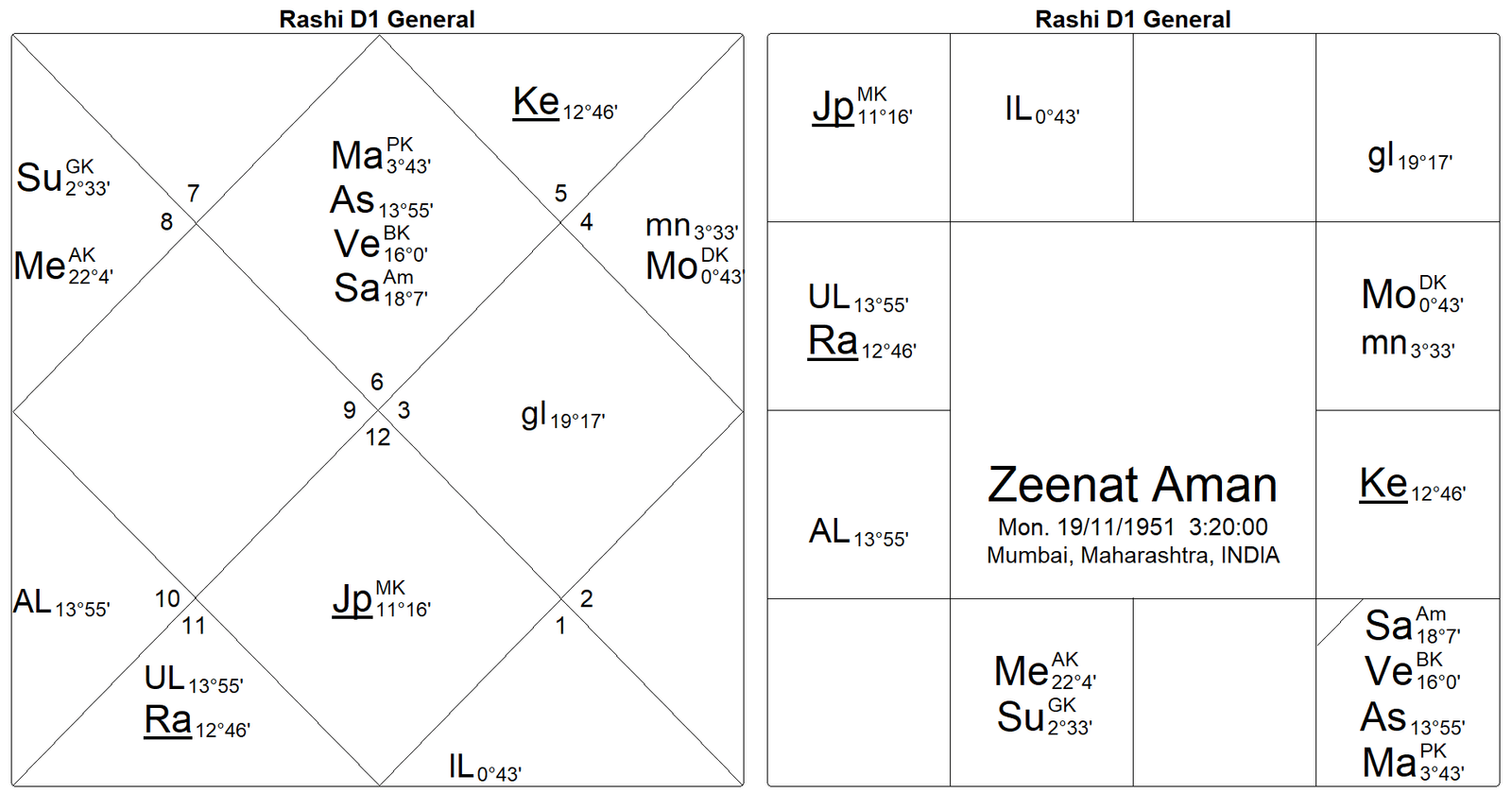
Horoscope Analysis
- This is a कन्या (Kanya / Virgo) Lagna chart. Virgo rising already gives a sharp, practical, earthy mind, and an instinct for the real and the material rather than the abstract or the otherworldly.
- The lagna lord बुध (Mercury) is in an exchange with मंगल (Mars). This Mercury-Mars parivartana, tied to the 3rd house of courage and self-assertion, produces a fierce, almost Kali-like boldness in the personality. This is a woman who can stand against the grain, defy convention, and push forward with raw nerve where others would hesitate. Courage and rebellion are written into the very core of the chart.
- मंगल (Mars), शनि (Saturn), and शुक्र (Venus) are all placed together in the लग्न. This triple loading of the 1st house gives an extremely bold, forceful, striking character. But it comes at a cost. The presence of 2 hard malefics, Mars and Saturn, sitting right on the ascendant also invites struggle, friction, and difficulty into the very fabric of her life. A personality this strong does not pass through the world quietly. It collects bruises.
- These same Mars and Saturn in the lagna throw their heavy aspect directly onto the 7th house, where गुरु (Jupiter) sits. So the 2 cruellest planets in the chart are pressing down hard on the patikaraka, the husband-significator.
- And this Jupiter is retrograde in the 7th house, and utterly afflicted. Here we meet, once again, the single unmistakable signature that has run through every chart in this section. The broken गुरु. Marilyn Monroe, Madonna, Brigitte Bardot, Zeenat Aman, and now here again, the patikaraka wounded and pressed. The same planet, broken the same way, in life after life.
- The लग्न does carry शुक्र (Venus), which lends her a measure of beauty and attractiveness. But if we are honest in our reading, she was bold far more than she was beautiful. The Indian screen had far greater beauties, a Hema Malini, a Madhubala, women whose loveliness was on another level altogether. Her power was never pure beauty. It was boldness, daring, and a raw, unmistakable sensuality, and that is exactly what the Mars-Saturn-Venus combination in the lagna produces. Not the soft, rooted grace of a Type 1 woman, but the fierce, magnetic heat of the अप्सरा.
- So गुरु is super afflicted in this horoscope yet again. And along with it, the 9th lord, the lord of dharma, is also afflicted, caught up with the malefics in the lagna. Both pillars of dharma in the chart, the patikaraka Jupiter and the 9th lord of fortune and righteousness, are struck down together.
The अप्सरा in the Horoscope: Chart 5

Monica Bellucci (born 30 September 1964)
If we are looking for the अप्सरा archetype expressed in its most complete and undiluted European form in our own era, Monica Bellucci is perhaps the clearest example alive. Where some sex symbols faded with youth, she became, if anything, more iconic with age, so much so that at the age of 51 she was cast as a Bond girl in Spectre, becoming the oldest woman ever to play that role. The world did not merely find her beautiful in her twenties. It found her beautiful across her entire life. She is sensual beauty made almost timeless.
She was born Monica Anna Maria Bellucci on 30 September 1964 in Città di Castello, a small town in the Umbria region of Italy, the only child of a modest family. Her father worked in agriculture and winemaking, her mother was a painter. There is a quietly beautiful detail in her birth. Her mother had been told by doctors that she was infertile, so Monica’s arrival was treated as something of a small miracle in the family.
She first set out to study law at the University of Perugia, and modelled only on the side to pay for her studies. But the modelling took over. In 1988 she moved to Milan, joined Elite Model Management, and went on to become the face of the great fashion houses, Dior and Dolce & Gabbana. From there she moved into cinema, with an American debut in Bram Stoker’s Dracula in 1992, and then true international stardom through the French thriller The Apartment in 1996. Her most acclaimed and defining role came in Malèna in 2000, where she played the beautiful young widow desired and destroyed by the gaze of an entire town. It was almost a portrait of the अप्सरा condition itself, a woman whose beauty becomes a public object that the world both worships and punishes.
She was repeatedly named among the most beautiful women in the world, and posed for famous nude calendars for Italian magazines at the height of her fame. Her sensuality was not incidental to her art. It was the very centre of her public identity.
And once again, behind the dazzling surface, the familiar pattern of the archetype appears. She married 2 times. First to the Italian photographer Claudio Carlos Basso in 1990, a marriage that ended within a few years. Then, in 1999, to the French actor Vincent Cassel, with whom she had 2 daughters, Deva and Léonie. That marriage, which the public saw as one of the most glamorous unions in world cinema, also ended, in divorce in 2013, after 14 years. Tellingly, even during that marriage the couple often kept separate apartments, by her own account to avoid the routine of conventional domestic life. Later relationships, including a widely reported partnership with the filmmaker Tim Burton, also came and went.
So the signature holds once more. Extraordinary, almost eternal beauty. Worldwide desire across an entire lifetime. Real artistry layered on top. And underneath it all, the marriages that form and dissolve, the home that is never quite settled, the woman who belongs to the gaze of the whole world and is never finally rooted in one quiet hearth. The earthbound nymph, in her Italian incarnation.
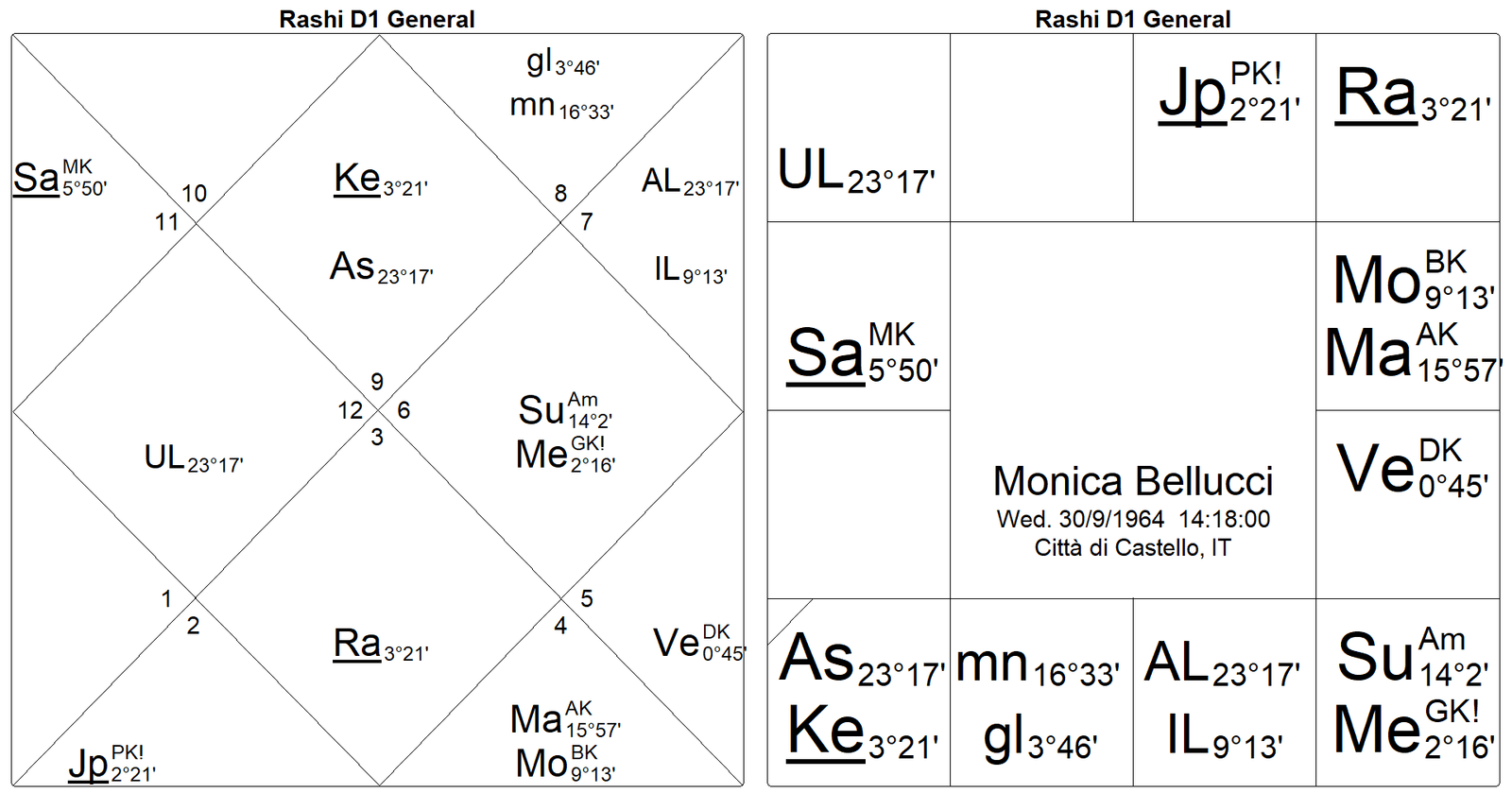
Horoscope Analysis
- This is a धनु (Dhanu / Sagittarius) Lagna chart, with केतु (Ketu) placed right in the लग्न. Ketu in the ascendant gives a certain detachment, a mystery, and an otherworldly quality to the personality, but it also unsettles the clean sense of self, leaving a subtle restlessness in how the person relates to their own identity.
- The lagna lord गुरु (Jupiter) is placed in the 6th house, retrograde, in the rashi of वृषभ (Taurus). This is the heart of the chart. When the lagna lord is retrograde, the very thing it was naturally meant to do, which for Jupiter is to walk the straight and proper path of dharma, gets turned backward. The dharmic instinct is there, but it does not move forward in the expected, conventional way. The retrogression pulls her off the standard dharmic road.
- And note where this happens. The retrograde lagna lord sits in the sign of शुक्र (Venus), Taurus, a sign of beauty, sensuality, and worldly pleasure. So her dharma-lord is not only turned backward, it is also placed squarely in the territory of Venusian enjoyment. The pull toward beauty and pleasure overrides the forward march of dharma.
- The चन्द्र (Moon) is placed in the 8th house, in the Pushya nakshatra. The Moon in the 8th gives emotional depth and a certain hidden intensity, the magnetic, mysterious quality that defined her screen presence, but the 8th house also brings turbulence, secrecy, and upheaval into the emotional and marital life.
- शनि (Saturn) is in the 3rd house, and शुक्र (Venus) aspects this Saturn in the 3rd. The Venus-Saturn connection again ties the chart’s energy toward relationships, desire, and the sensual, even through the house of courage and self-expression.
- Now here is what makes this chart comparatively better than the ones we studied before. The 10th lord is in the 10th house, exalted, along with the 9th lord. This is a genuine point of strength. The houses of karma and dharma are dignified here, which is why she had real artistic substance, a long and respected career, and a relationship that lasted a full 14 years, far more stability than a Marilyn Monroe or a Brigitte Bardot ever found.
- But it is still not clean, and the marriage still could not finally hold. The reason is the same recurring signature. गुरु, the patikaraka and lagna lord, is retrograde and afflicted in the 6th house. The husband-anchor of the chart is turned backward and weakened.
- And looking closely, the 9th house itself, the seat of dharma, is somewhat afflicted too. It carries the presence of शुक्र (Venus), which is the 6th lord, and it receives the aspect of शनि (Saturn). So even though the 9th and 10th lords are strong in the 10th, the 9th house as a place is touched by the 6th lord and by Saturn, leaving the dharmic foundation partly disturbed.
The Navamsha (D-9): The Truth of the Marriage
A Short Note Before We Look at the Navamsha
Until now, in every horoscope we have discussed, I have deliberately kept the analysis to the Rashi chart alone. This was a conscious choice, made only to keep things simple and readable for those who are new to Jyotish. The Rashi chart gives us the broad picture, the outer structure of a life, and for a beginner that is already a great deal to absorb at once.
But let me be very clear about something. The नवांश (Navamsha) can never be ignored. Never.
My Guruji says something about this that has stayed with me. He says that an astrologer who ignores the use of the Navamsha is committing a karmic crime, almost a sin, in the practice of Jyotish. And he is right. The Rashi chart shows the promise. The Navamsha shows whether that promise is real or hollow. A planet may look strong and dignified in the Rashi chart, but if it falls apart in the Navamsha, that strength is only a painted surface with nothing behind it. This is especially true for the matters of marriage, dharma, and the inner life of a woman, which is exactly what this article is about. To read a woman’s chart for marriage and never open her Navamsha is to read only half the truth and then speak as if it were the whole.
In honesty, it is not even the Navamsha alone. The proper way is to examine the entire Shadvarga, the 6 divisional charts, before pronouncing any judgement on a horoscope. A serious Jyotishi never rests on 1 chart. But if I were to open all 6 divisions for every woman in this article, the piece would grow so long that no reader would ever reach its end.
So I have chosen a middle path. I will keep the deeper analysis up to the Navamsha. For each of these women, I will now show the Navamsha and explain it briefly, just enough to confirm or break what the Rashi chart promised. Take this as an invitation, not a conclusion. The doors of the deeper divisional charts are always open for those who wish to walk further in.
With that said, let us now turn to the Navamsha.
Monica Bellucci
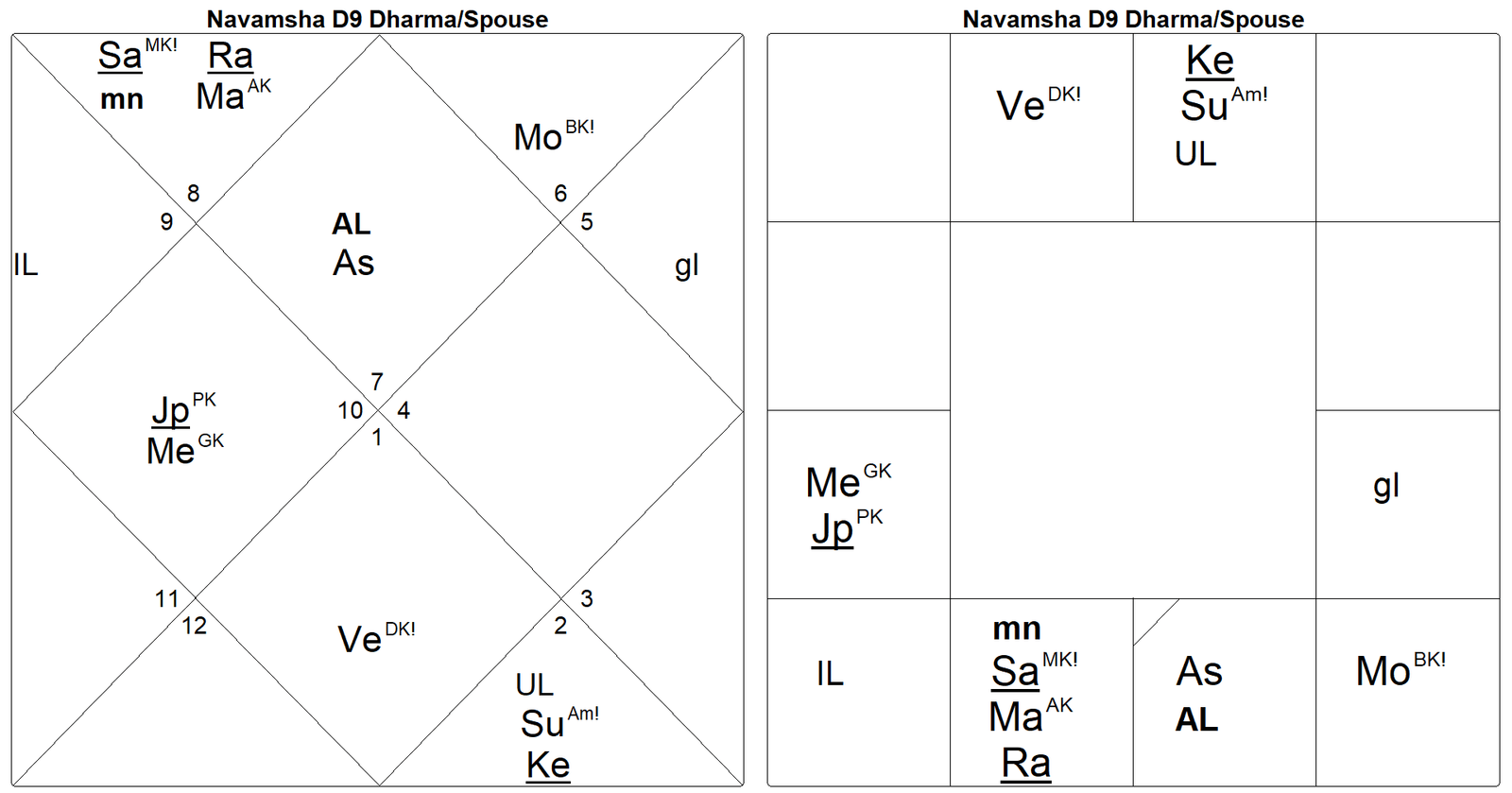
- In the Navamsha, the lagna is तुला (Tula / Libra) rising, and शुक्र (Venus) is aspecting that lagna. This placement alone says a great deal. It is well established in the teaching of Shri K.N. Rao that the Navamsha lagna reveals the actual physical beauty of a person, the quality of the skin, the true form of the body beneath the outer presentation. With Libra rising and Venus casting its aspect onto the lagna, the Navamsha quietly confirms her famous, sensual physical beauty at the deepest level of the chart.
- But notice the source of that aspecting Venus. It comes from मेष (Aries), a sign of मंगल (Mars). So the very planet of beauty is throwing its grace from a fiery, Martian sign. This is the signature of a beauty that is not soft and domestic but charged, intense, and powerfully sensual. The Venus in a Mars sign quietly shows the heat behind the loveliness.
- There is heavy affliction on the 2-8 axis of the Navamsha. This axis governs family, longevity of marriage, and the joining of 2 lives. When it is afflicted in the D-9, it speaks directly and unmistakably about the condition of the married life, whatever form that life finally took. The chart confirms here, at the soul level, the instability of her unions that the Rashi chart had already hinted at.
- गुरु (Jupiter) is debilitated in the Navamsha and aspected by शनि (Saturn). This is the crucial confirmation. The patikaraka, which was already retrograde and afflicted in the 6th house of the Rashi chart, does not recover in the D-9. It falls further, into debilitation, and is then pressed by the aspect of Saturn. The husband-significator is compromised at every level of the chart. There was no hidden reservoir of marital strength waiting in the Navamsha to save the marriage. The wound to Jupiter goes all the way down.
- शुक्र (Venus) sits in a sign of मंगल (Mars), which makes her sexually strong and magnetic. This confirms the very same reading we drew from the Rashi chart. The sensual force of the chart is real and consistent across the divisions, not a surface impression.
- And finally, सूर्य (Sun), which is the 9th lord of the birth horoscope, the lord of dharma, is again afflicted in the Navamsha, placed in the rashi of वृषभ (Taurus). This is the deciding point. The 9th lord, the dharmic anchor, is okay in rashi but wounded in the Navamsha.
Zeenat Aman
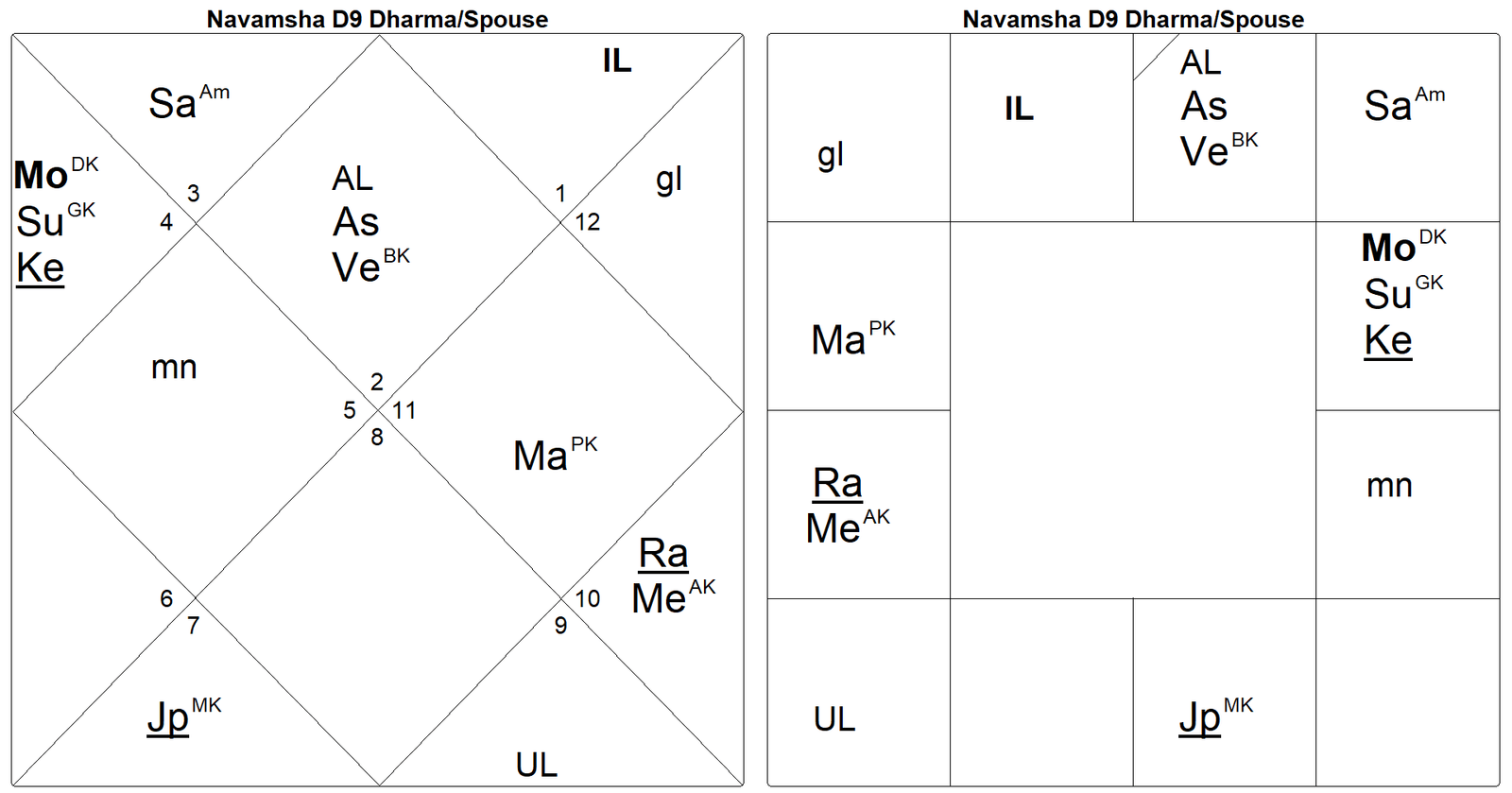
- In the Navamsha, गुरु (Jupiter) is retrograde in the 6th house. This is the deciding confirmation of the entire chart. The patikaraka, the husband-significator, does not recover in the D-9. It falls into the 6th house, the house of conflict, debt, and discord, and it sits there retrograde, turned backward, exactly as the broken गुरु signature demands. There was no hidden strength in the soul-chart waiting to rescue her marriages. The wound to Jupiter runs all the way down.
- शुक्र (Venus) sits in the लग्न of the Navamsha, and it is aspected by मंगल (Mars). And the aspect of Mars upon it gives that beauty its bold, charged, sensual quality, not soft and domestic but fiery and magnetic. This is the exact signature of the modern अप्सरा, beauty fused with heat.
- शनि (Saturn) aspects the 8th house of the Navamsha. The 8th house governs the longevity and survival of the marriage, and a malefic Saturn striking it is poor for marital endurance. The union does not get the quiet stability it needs to last. This is the chart-level reason her marriages could not survive the long road.
- मंगल (Mars) and शनि (Saturn) both aspect the 4th house of the Navamsha. The 4th house is the seat of domestic peace, the home, the inner emotional sanctuary. When the 2 great malefics fall upon it together, that domestic peace is shattered before it can ever settle. This shows the disturbed, painful home life she actually lived through, the broken first marriage marked by assault, and the long, troubled second marriage that gave her no rest.
Brigitte Bardot
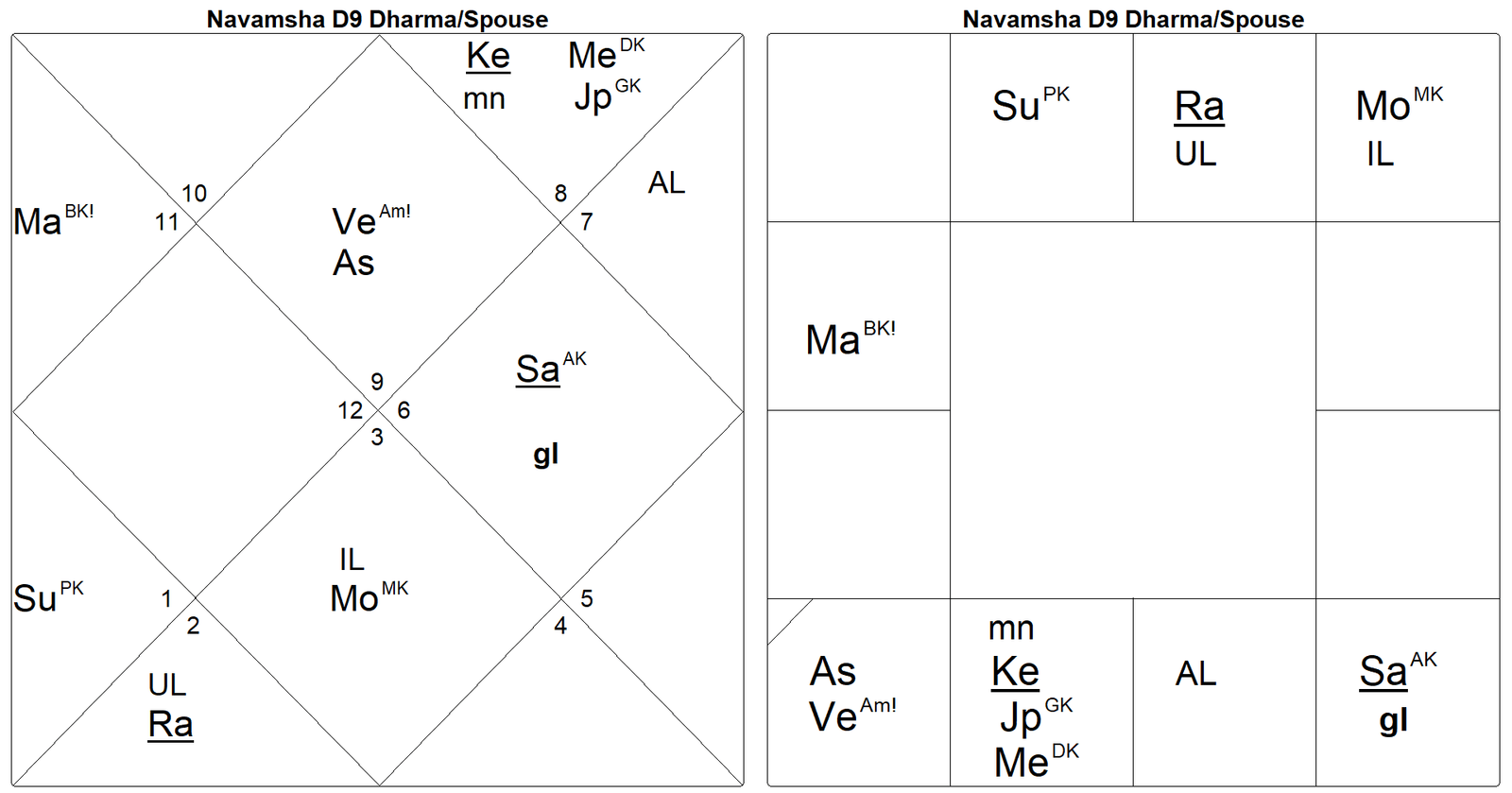
- In the Navamsha, शुक्र (Venus) is placed in the लग्न, and it is aspected by चन्द्र (Moon). With Venus sitting in the lagna and the Moon casting its aspect upon it, the 2 great planets of beauty and feminine charm come together right at the seat of the body. This confirms, at the deepest level of the chart, the extraordinary beauty she carried, the beauty that made her the very face of European sensuality.
- गुरु (Jupiter) is placed in the 12th house of the Navamsha, sitting with केतु (Ketu), and aspected by शनि (Saturn). Here is the broken patikaraka once again, confirmed in the D-9. Jupiter is pushed into the 12th, the house of loss, dissolution, and the foreign, joined to the detaching, severing energy of Ketu, and then pressed further by the aspect of Saturn. The husband-significator is afflicted from every side. There was no recovery for Jupiter in the soul-chart. The wound only deepened.
- The 7th lord is also placed in the 12th house of the Navamsha. The 7th lord is the lord of marriage and partnership, and when it falls into the 12th house, the house of beds, hidden things, and secret pleasures, it points clearly to clandestine relationships and affairs conducted away from the open light of a settled marriage. This matches the actual pattern of her life, the relationships that ran alongside and outside her formal unions.
- There is 1 more layer to this गुरु-केतु (Jupiter-Ketu) conjunction in the 12th house. The 12th is not only the house of loss. It is also the house of मोक्ष, of withdrawal from the world and of selfless service. So गुरु, the planet of dharma, meeting केतु, the planet of renunciation, in this house plants a real seed of vairagya, a quiet pull away from worldly life toward something higher.
- And that is exactly how her life turned. At around the age of 40, at the height of her fame, she walked away from cinema entirely and gave the rest of her life to animal welfare. The humanitarian thread is clearly visible here, the गुरु-केतु in the 12th house of salvation, linked with the 10th lord of karma, turning her later life into one of service.
So the same Jupiter that was broken for marriage carried, in its meeting with Ketu, the faint spiritual thread that finally pulled her out of the अप्सरा life and into something quieter and more selfless.
Madonna
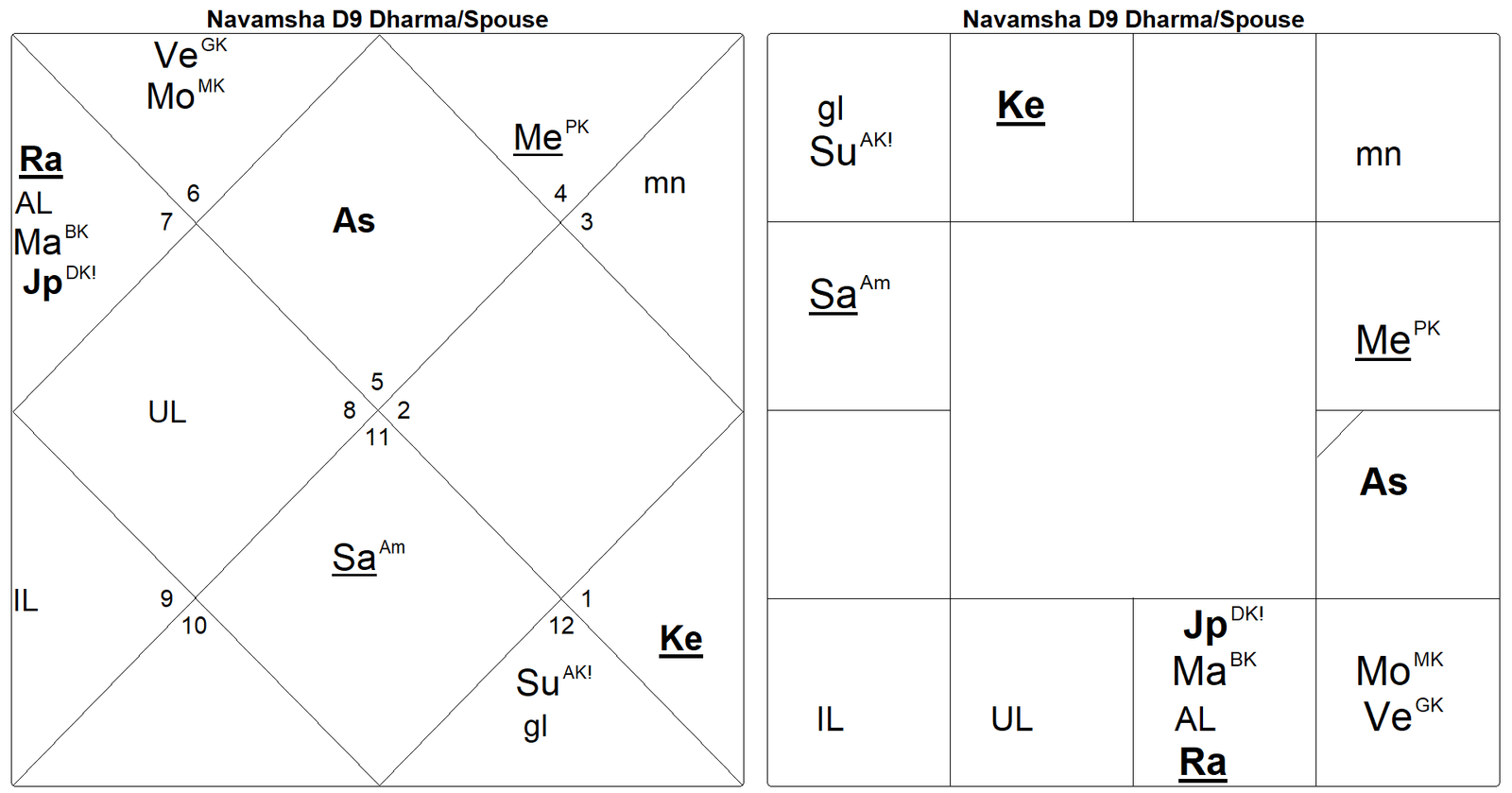
- In the Navamsha, the lagna is सिंह (Simha / Leo) rising. As we established, the lagna lord is always the planet to watch most closely, because it carries the self. So in this chart everything turns on the condition of सूर्य (Sun), the lord of Leo.
- This lagna lord सूर्य (Sun) is placed in the 8th house of the Navamsha, aspected by शुक्र (Venus) and चन्द्र (Moon). The self falling into the 8th house gives that quality of constant reinvention, upheaval, and transformation that defined her entire career, a personality that keeps dying to its old form and being reborn in a new one. And with Venus and the Moon, the 2 planets of beauty and emotion, casting their aspect upon it, that 8th-house self is fused with sensuality and public feeling.
- The चन्द्र-शुक्र (Moon-Venus) combination in the 2nd house is a classic and very powerful signature for a singer. The 2nd house governs the voice, and these are the 2 planets of music, melody, and artistic beauty sitting together in the house of the voice. The Navamsha itself confirms, at the soul level, that she was born to be a musician and a performer. Her singing career was not accidental. It was written into the D-9.
- गुरु (Jupiter) sits with राहु (Rahu) and मंगल (Mars) in the 3rd house. This is the decisive confirmation of the whole chart. The same गुरु-चाण्डाल pattern we saw in the Rashi chart, Jupiter bound up with Rahu and Mars, repeats in the Navamsha. So the affliction to the patikaraka and dharma-karaka does not soften at the deeper level. It is carried all the way down. The compromised, rebellious Jupiter is consistent across both charts.
Marilyn Monroe
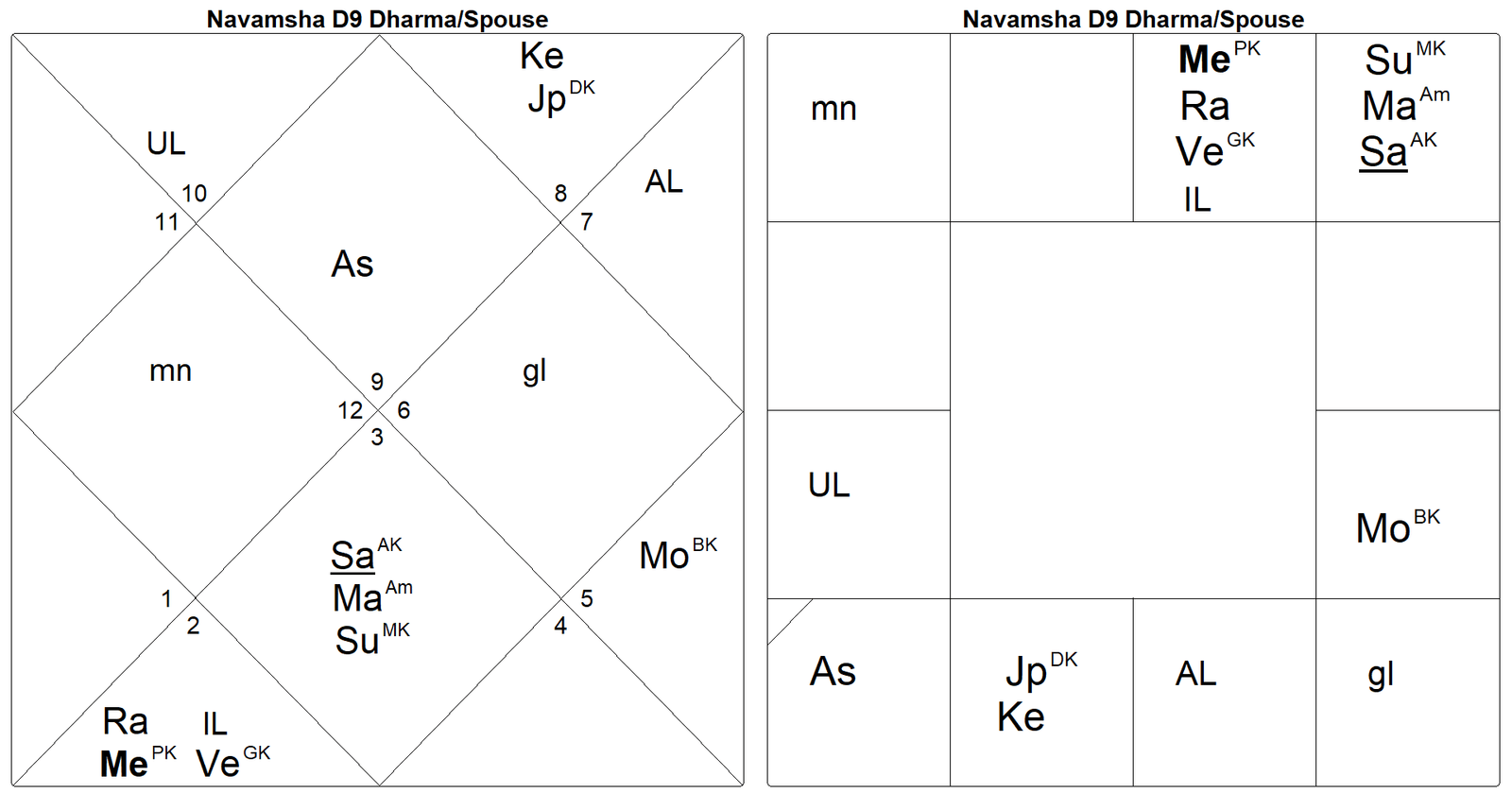
- Of all the women we have studied in this section, Marilyn Monroe died the earliest and met the worst end. She was gone at just 36, in circumstances that remain unclear to this day, whether suicide, accident, or something darker. And yet, with a strange irony, she remains the single most idealised sex symbol of all. Countless American actresses and models even today look back at her as the very image of what they wish to become. The Navamsha shows us why her end was so tragic, even as her image became immortal.
- In the Navamsha, धनु (Dhanu / Sagittarius) is rising, and it is severely afflicted. This is no quiet lagna. It is a battlefield.
- The 7th house of the Navamsha, मिथुन (Gemini), is crowded with malefics. शनि (Saturn), मंगल (Mars), and सूर्य (Sun) are all posited there together. The 7th is the house of marriage and partnership, and here it carries the harsh, separative weight of 3 difficult planets at once. Saturn brings coldness, delay, and burden. Mars brings conflict and aggression. The Sun brings ego and separation. With these 3 sitting together in the very seat of marriage in her soul-chart, the foundation of any lasting union is broken from the deepest level. This is the precise astrological reason no marriage could ever hold for her.
- The lagna lord गुरु (Jupiter) is placed in the 12th house, aspected by शुक्र (Venus) and बुध (Mercury). The lord of the self falling into the 12th house, the house of loss, beds, and dissolution, shows a self that was never truly grounded in itself, always slipping away, always belonging elsewhere. And with Venus and Mercury aspecting it, that self is wrapped in beauty and charm, the very allure she carried and projected to the world even as her own inner ground dissolved beneath her.
- The चन्द्र (Moon), which is the 8th lord, is placed in the 9th house. So the lord of the 8th, the house of death, upheaval, and hidden things, is sitting in the 9th house of dharma and fortune, carrying that 8th-house darkness directly into the seat of her dharma. The 9th house is afflicted as a result, just as the 7th house is destroyed and the lagna lord is exiled to the 12th.
Anandmayi Ma
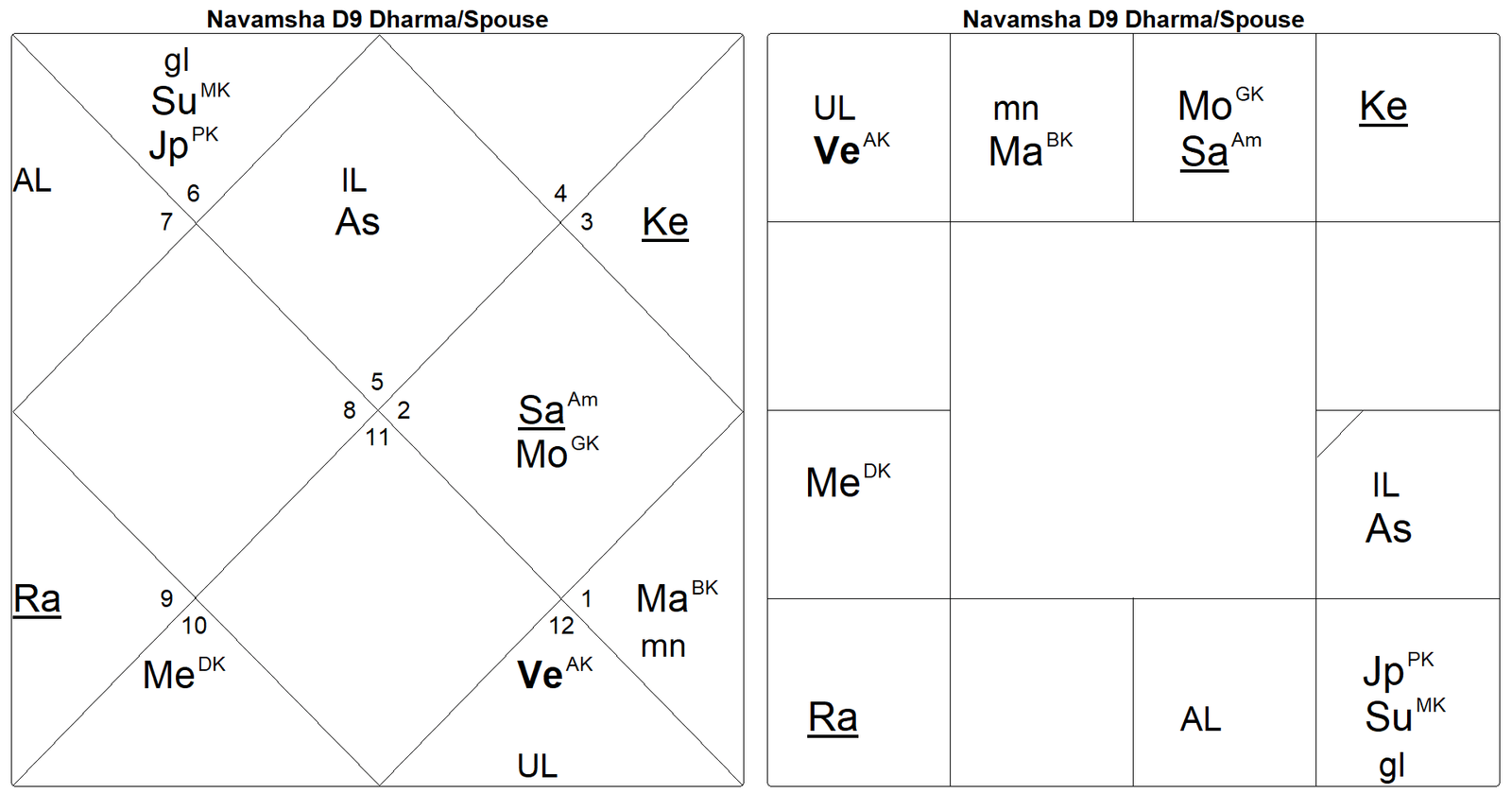
- In the Navamsha, सिंह (Simha / Leo) is rising, and शुक्र (Venus) is exalted in the 8th house. Remember that Venus is the Atmakaraka of this chart and the planet of the woman herself. To find it exalted even in the Navamsha, and placed in the 8th house, the house of the deepest mysteries and hidden spiritual knowledge, shows a soul whose innermost being is devoted to the occult depths of the divine. The beauty here is not of the body. It is the beauty of a being drowned in the mysteries of the Supreme.
- The lagna lord सूर्य (Sun) is under powerful benefic influence. The self of the chart is held and blessed by auspicious planets, which is why her very presence radiated grace and purity rather than worldly magnetism.
- गुरु (Jupiter) is placed in the 2nd house, with the aspect of शुक्र (Venus) upon it, and with सूर्य (Sun) in a very fine position, all of this strengthening the chart beautifully. Here is the heart of the matter. Where every apsara we studied had a गुरु that was broken, retrograde, combust, or afflicted in the Navamsha, Anandamayi Ma’s गुरु sits dignified, aspected by benefic Venus, supported by a well-placed Sun. The patikaraka and dharma-karaka is whole and luminous in the deepest chart. This single difference is the entire difference between the अप्सरा and the avatara.
- The 10th lord is exalted in the 8th house. The lord of karma, exalted, sitting in the house of secret sadhana, shows that her life’s work was done in the hidden depths, through tapasya and inner realization rather than outer display.
- The 12th lord is exalted in the 10th house, sitting with शनि (Saturn). The 12th is the house of moksha, and its lord exalted in the 10th house of action means her entire public karma was pointed toward liberation. Her work in the world was the work of moksha itself.
- The शनि-चन्द्र (Saturn-Moon) combination is the classic yoga of संन्यास, of renunciation. Saturn, the great renouncer, joined with the Moon, the mind, turns the very mind toward detachment and withdrawal from the world. This is the chart-level root of her lifelong, natural renunciation, the same renunciation that made even her marriage a celibate one.
- The 9th lord is in its own sign, which keeps the seat of dharma clean, strong, and self-sustaining. The dharmic foundation of the chart is unbroken.
- And this Saturn-Moon combination in the 10th house is aspected by गुरु (Jupiter). When Jupiter, the karaka of wisdom and dharma, throws its grace upon the Saturn-Moon sanyas yoga, it lifts the renunciation of the mind into something luminous and spiritual. The mind is not merely detached. It is turned, by Jupiter’s blessing, toward God. This is the precise signature of a mind established in the divine.
- So when you place this Navamsha beside the Navamshas of the women in the apsara section, the contrast is breathtaking. There, the patikaraka was broken at the deepest level, the 7th house destroyed, the feminine planets charged with sensuality and pointed at the world. Here, गुरु is whole and blessed, the mind is turned toward sanyas by the Saturn-Moon yoga, the 10th and 12th lords are exalted and pointed at moksha, and the 9th lord rests clean in its own sign. The same divisional chart that exposed the broken dharma of the अप्सरा here reveals the unbroken dharma of the avatara. This Navamsha, compared to all the others, is simply beautiful. It is the soul-chart of a woman who came into this world already belonging entirely to the divine.
More Charts for the Discerning Reader
In the horoscopes above, I have walked through the analysis in detail. But the real joy of Jyotish lies in seeing the pattern for yourself. So in this final section, I am placing before you the charts of several more well-known women of this same archetype, without my commentary.
Look at each one with the parameters we have built through this article. Find the गुरु and check its condition. See whether it is afflicted, retrograde, combust, or trapped in a dusthana. Look at शुक्र and चन्द्र, the 2 planets of the feminine, and see where they stand. Check the 7th house and its lord. And then open the नवांश and see whether the Rashi chart’s promise holds or breaks. Read them as a Jyotishi now, not as a reader.
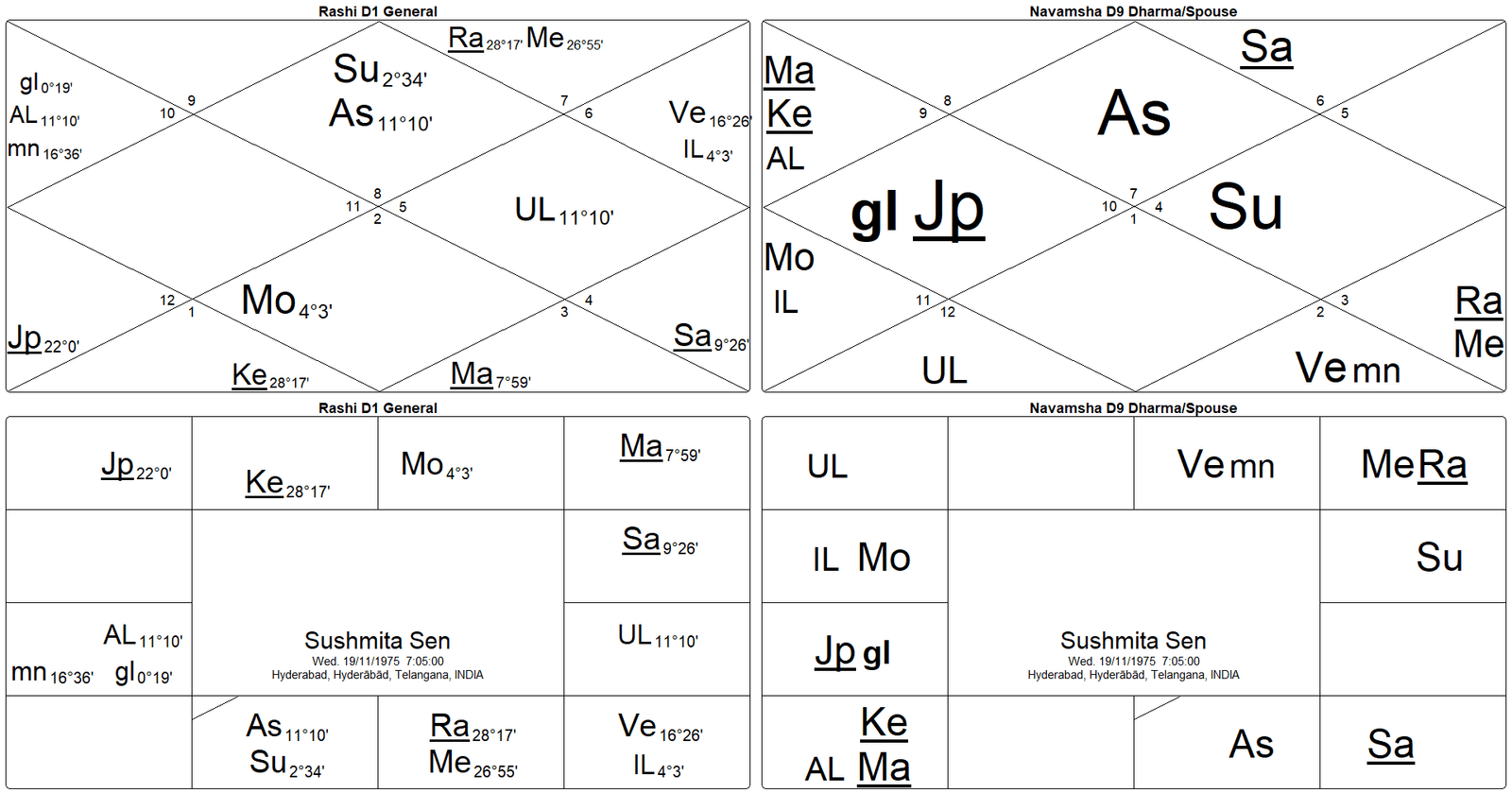
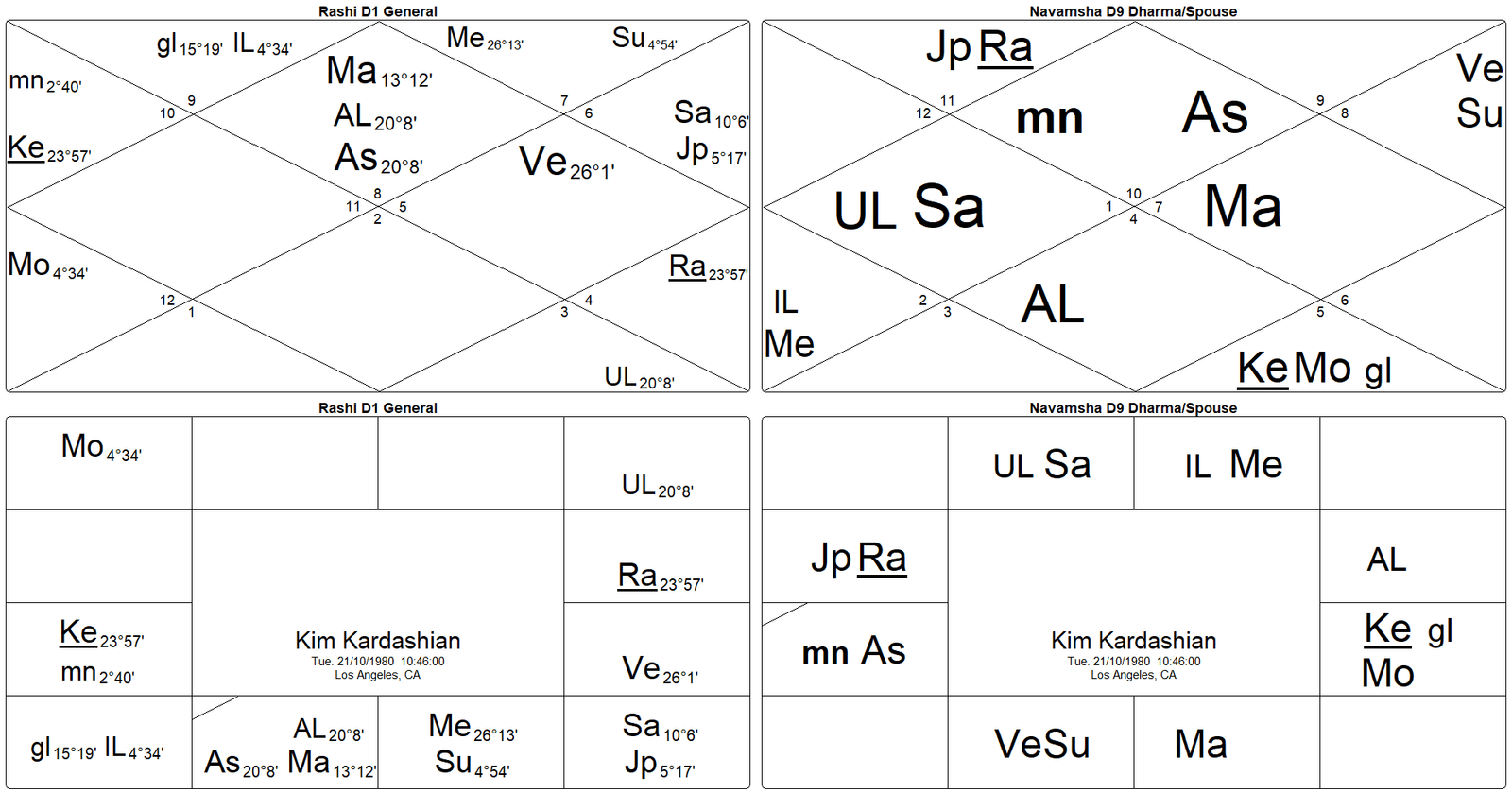
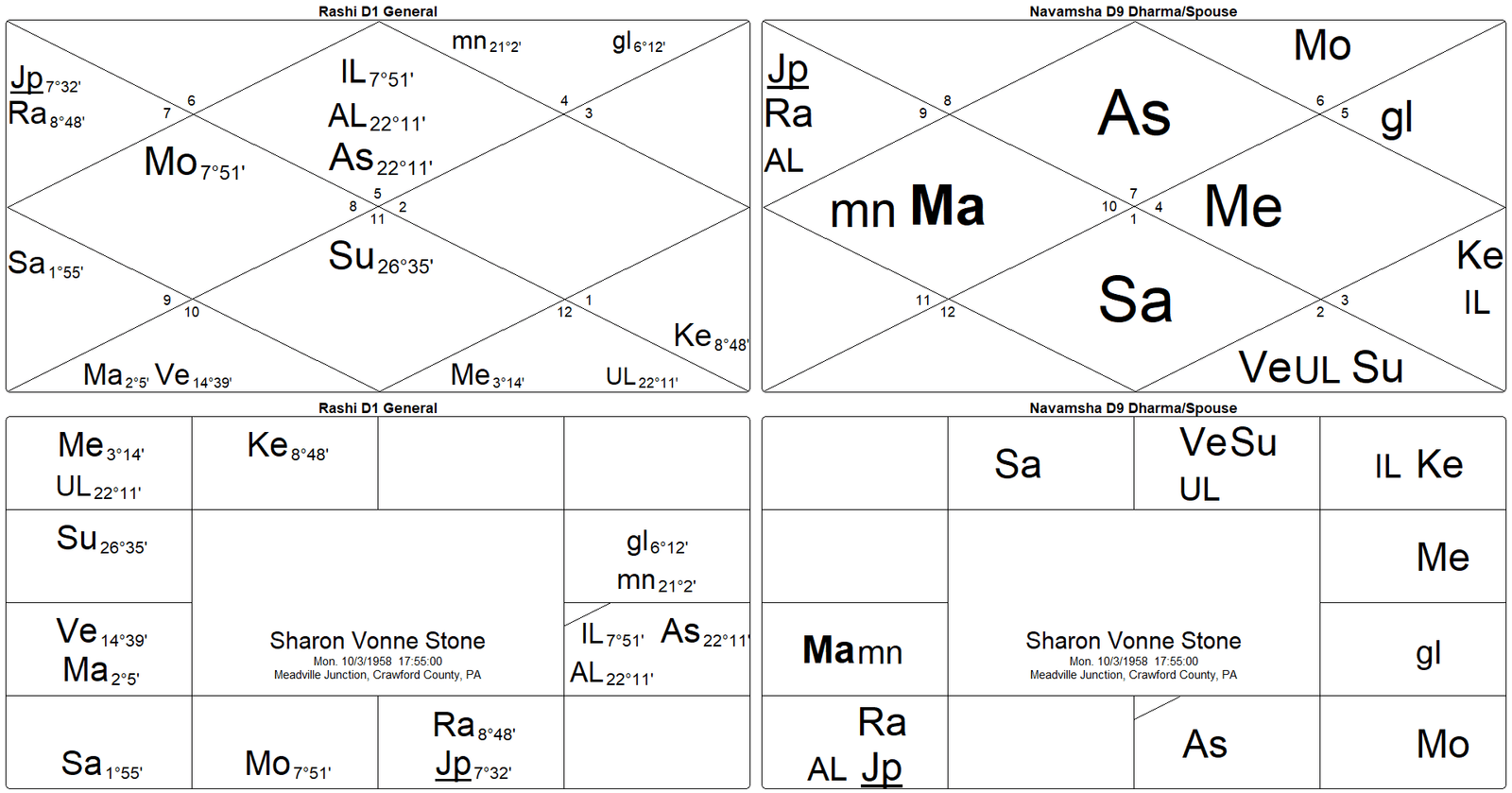
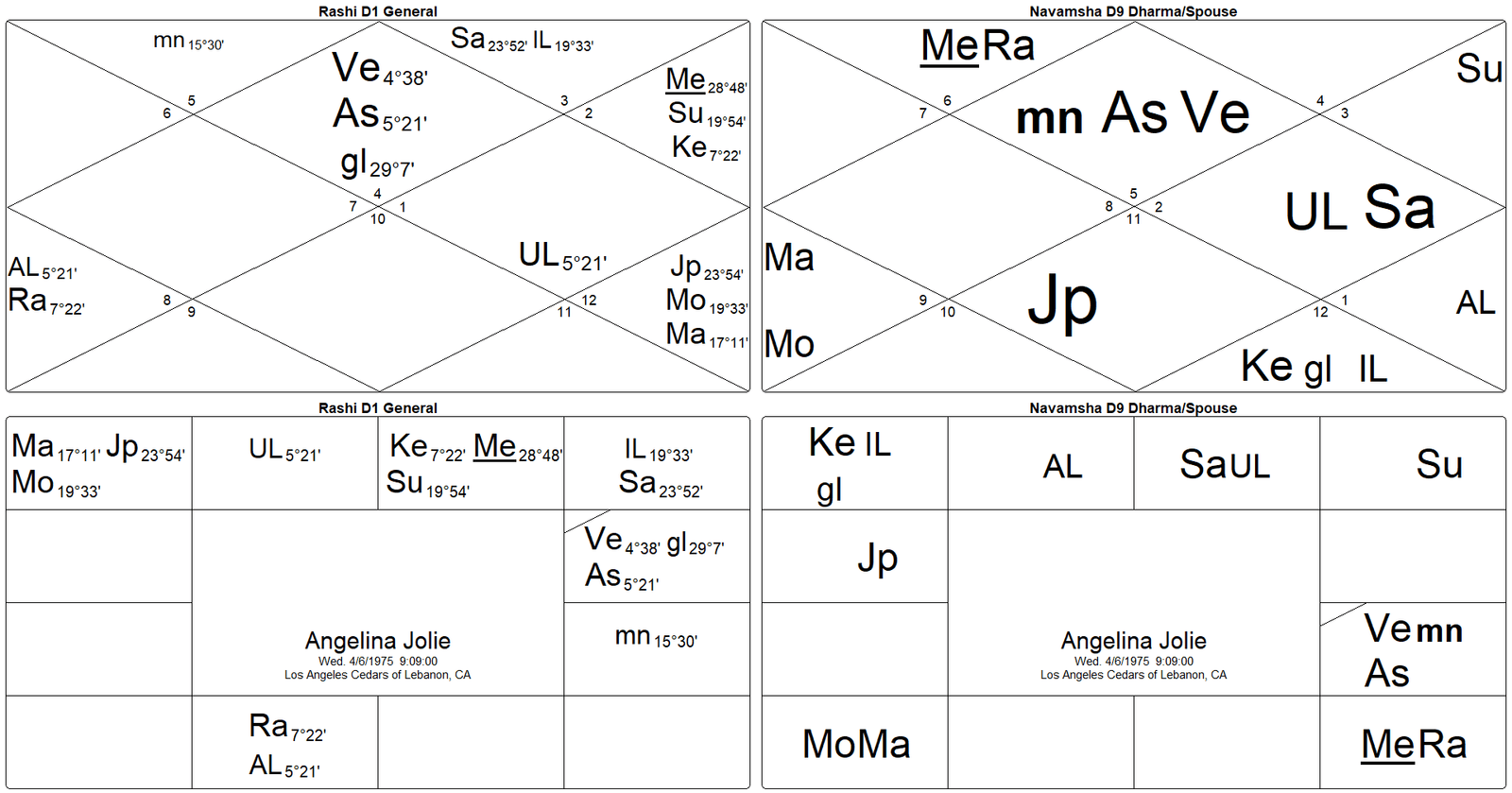
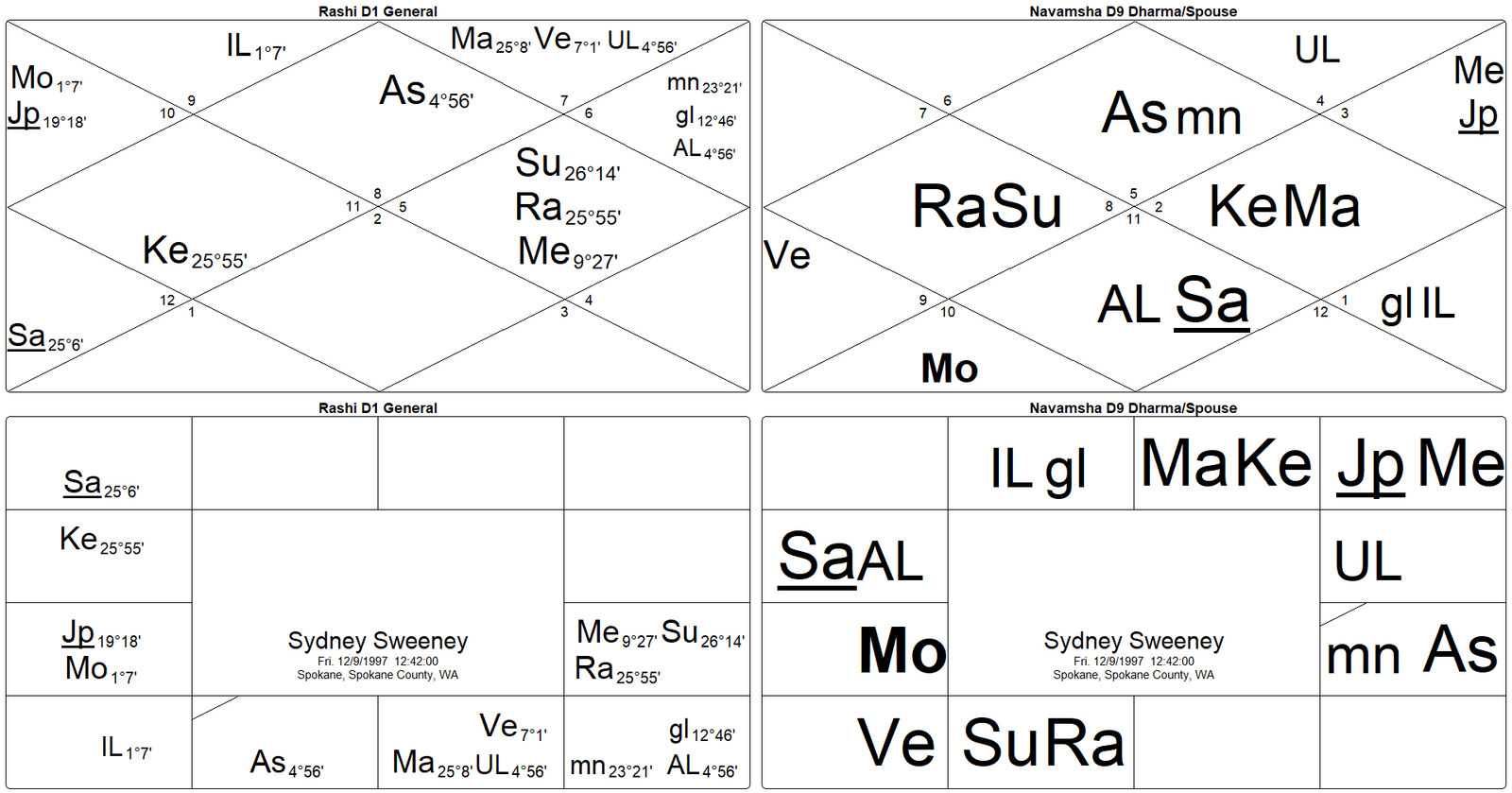
The साध्वी-गृहस्थिनी: The Householder Saint
We have seen the अप्सरा, and we have seen the साध्वी-विरक्ता who stood outside marriage. Now let us look at a woman who was fully a गृहस्थिनी and yet deeply spiritual.
She was married and a mother. All her children flourished and outlived her. One became a great Guru of Jyotish. She herself mastered the महामृत्युंजय mantra, and in her final days could see the unseen and predict even without a horoscope. Her death too was a conscious, spiritual one.
She is kept anonymous here, but her chart speaks for itself. This is the proof that a woman need not leave marriage and motherhood to reach the heights.
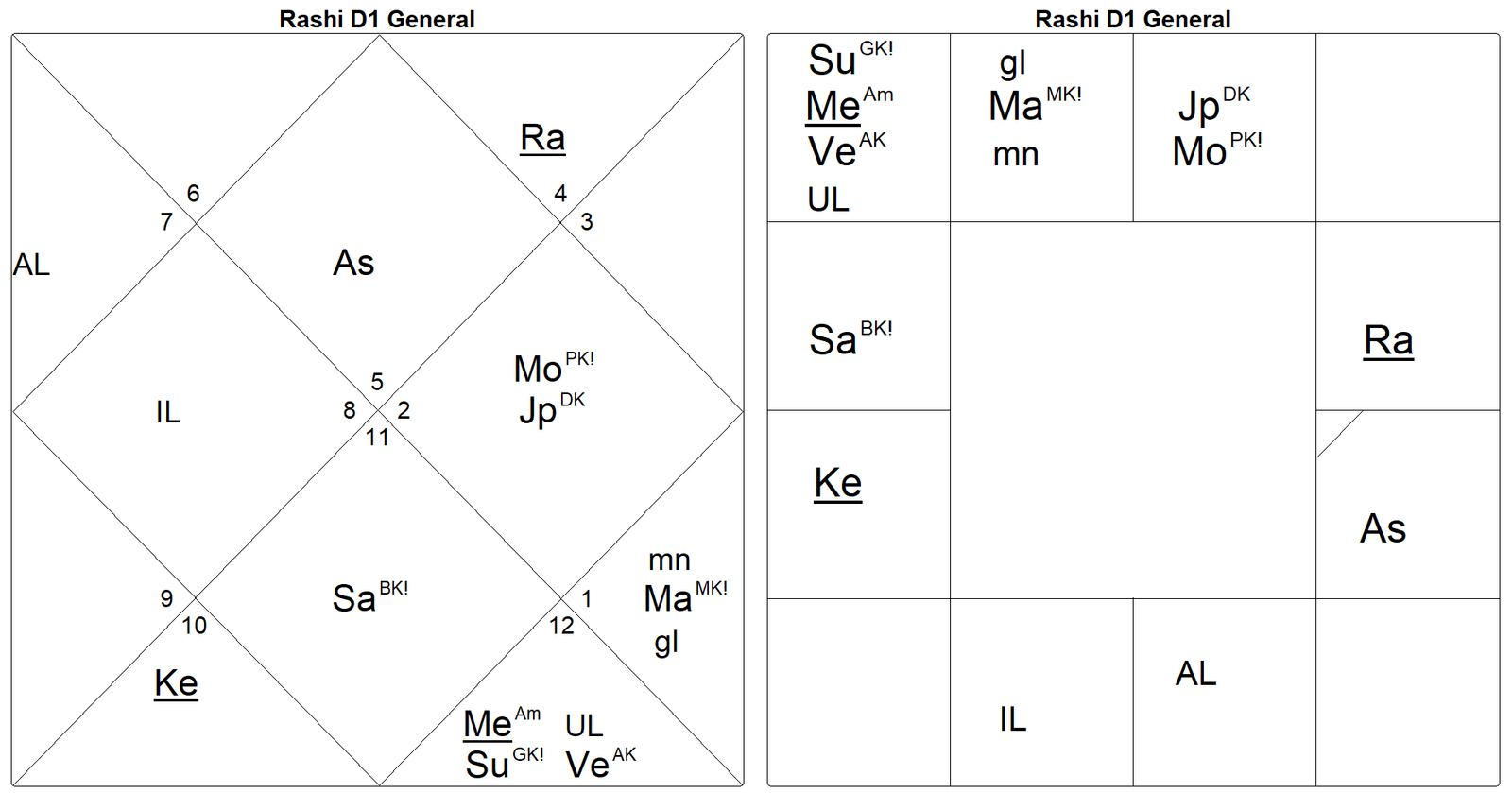
Astrological Analysis
- The लग्न is सिंह (Simha / Leo). And immediately the chart begins to rhyme with something we have already seen. शुक्र (Venus) is exalted in the 8th house and चन्द्र (Moon) is exalted in the 10th house. This is strikingly similar to the Navamsha of Anandamayi Ma, the same exalted Venus in the 8th, the same elevated feminine planets. The signature of a deeply spiritual woman is written here from the very first glance.
- गुरु (Jupiter) is in the 10th house, and it is unafflicted, clean, and dignified. This is the heart of the difference. Where the अप्सरा charts carried a broken, retrograde, or combust गुरु, here the patikaraka and dharma-karaka is whole. Jupiter is not tainted. And this is why her life took the form it did, a married, rooted, dharmic life crowned with spirituality rather than scattered into rootlessness.
- The 5th lord in the 10th house is a beautiful combination for children. The 5th house is the house of progeny, and its lord rising into the 10th gives healthy, elevated, successful offspring. This is the chart-level reason her children flourished, none met a bad end, and one even rose to become a great Guru of Jyotish. The 5th lord placed this well does not merely give children. It gives children who shine.
- शनि (Saturn) is in its own rashi in the 7th house. The 7th is the house of marriage, and Saturn here in its own sign gives a stable, enduring, dutiful married life. She married, and the marriage held. The 7th lord is in a decent position, and the marriage was sound.
- The 2nd house of family is not truly afflicted. So the family she built was healthy and unbroken, the very opposite of the wounded 2nd houses we saw in the apsara charts. She had a real family, a real home, and it stood firm.
- And yet, alongside all of this worldly completeness, she was profoundly spiritual. The 12th lord, the lord of moksha, is exalted and sits with गुरु (Jupiter), and the 8th lord too is connected to the 10th house. So the houses of liberation and deep inner knowledge are exalted and tied to her Jupiter and to her public life. Her spirituality was not separate from her household. It was woven right through it.
- So look at what this single chart proves. The 5th lord well placed gave her flourishing children. Saturn in own sign in the 7th gave her a stable marriage. The 2nd house unafflicted gave her a sound family. And the exalted 12th lord with an untainted गुरु gave her genuine spiritual mastery, the महामृत्युंजय siddhi, the त्रिकालदृष्टि of her final days, and a conscious spiritual death. She did not have to choose between the home and the divine. Her chart let her hold both at once. This is the साध्वी-गृहस्थिनी, the householder saint, and her horoscope is the living proof that marriage and motherhood, when गुरु and the dharmic pillars are strong, are no obstacle whatsoever to the very highest spiritual attainment.
Conclusion:
We have travelled a long way in this article. From the churning of the cosmic ocean and the courts of Indra, down through the forests where Vishwamitra sat in tapasya, and finally onto the screens and stages of our own modern world. And through this entire journey, across mythology and shastra and the real horoscopes of real women, 1 single truth has repeated itself so many times that it can no longer be called a coincidence.
The character and the destiny of a woman turn upon the condition of गुरु in her chart.
गुरु is the पतिकारक, the significator of the husband. गुरु is the karaka of dharma, of saubhagya, of the rooting of a life in righteousness. When this 1 planet stands whole and dignified in a woman’s chart, her beauty, her intelligence, and her shakti find a dharmic home, and she rises. When this same planet is broken, fallen into a dusthana, retrograde, combust, or hemmed in by malefics, the very same beauty and shakti are left without an anchor, and she becomes the अप्सरा, the celestial nymph who dazzles the whole world and yet belongs to no single hearth.
We saw this with our own eyes, chart after chart. In Anandamayi Ma, in Mata Amritanandamayi, and in the householder saint, गुरु was strong, exalted, or untainted, the 9th and 10th lords were dignified, and the mind was turned by Saturn and the Moon toward the divine. These women reached the very heights of the spirit, 1 outside marriage, 1 never marrying, and 1 fully as a wife and mother, proving that the path matters less than the strength of dharma behind it. And then in Marilyn Monroe, in Madonna, in Brigitte Bardot, in Zeenat Aman, in Monica Bellucci, we saw the mirror image. The same broken गुरु, the same wounded 9th house, the same शुक्र and चन्द्र charged with sensuality and pointed outward at the world. And crucially, when we opened the नवांश, the deepest chart, the pattern never reversed. What was broken in the Rashi chart stayed broken in the Navamsha. The promise and the truth agreed.
This is the quiet power of Jyotish. It does not flatter and it does not lie.
But let me close by saying clearly what this article is not. It is not a judgement upon these women. Our shastras themselves forbid such a judgement. The अप्सरा is not a fallen soul. She rose from the same sacred churning that gave the world अमृत. The tradition that we follow placed Pingala, a courtesan, among the 24 gurus of Dattatreya. The same tradition asks us to remember the पञ्चकन्या, Ahalya, Draupadi, Tara, Kunti, and Mandodari, every single morning as purifiers of sin, though not 1 of them lived a conventional life. So when we say a chart carries the अप्सरा signature, we are speaking only of dharmic station in this 1 birth, the role the soul has taken up this time around. We are never speaking of the worth of the soul itself. The beauty is real. The shakti is real. The divinity is real. Only the rooting is absent.
And we must remember the age we live in. In कलियुग, धर्म stands on a single leg, and the boundaries between all 4 types of women have blurred. The साध्वी has become rare. The grihastha has grown unstable. And the अप्सरा has moved from being a rare celestial deployment to a mass phenomenon worshipped on a billion screens. This is not the fault of any 1 woman. It is the Yuga itself expressing through them. To see this clearly is not to condemn anyone. It is to understand the times with open eyes.
So what, in the end, is a woman?
She is, as the Gita tells us, the very embodiment of कीर्ति, श्री, वाक्, स्मृति, मेधा, धृति, and क्षमा, the shaktis that hold the world together. Whether those shaktis become the grace of a saint or the allure of a nymph is not decided by the woman’s worth. It is decided, in the precise and silent mathematics of the horoscope, by the condition of a single planet.
ॐ तत् सत्।
awesome article! salute!
Amazing piece of writing.
Awesome article. So deeply articulated with shastras and then given wide range of examples.Havent read this type of article at least in astrology domain.
Very deeply researched.